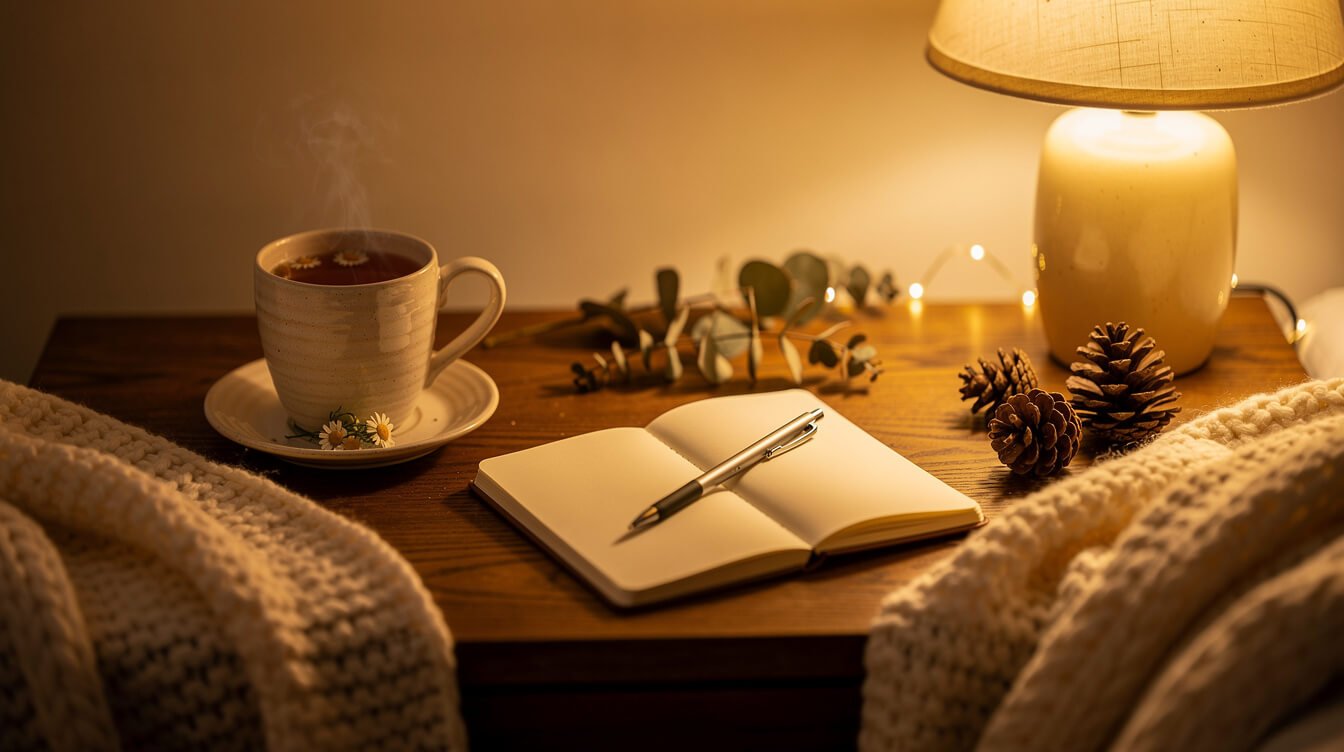
FAQ Friday: Holiday Stress and Sleep — 5 Gentle Answers Before Thanksgiving Week
Thanksgiving is next Thursday, and for many of us the holiday season is already speeding up. There are travel plans, menus, gift lists, and a calendar that suddenly has no white space. It’s no surprise that sleep is often the first thing to slip. Today’s FAQ Friday answers five common questions about holiday stress and sleep, with small, realistic steps you can start this weekend. 🌿
1. Why does holiday stress seem to follow me to bed?
Stress keeps your mind in “planning mode.” When you finally lie down, the unfinished list (call the airline, buy the cranberries, wrap the gifts) tends to get louder. Bedtime worry about incomplete tasks is a well-known reason people take longer to fall asleep. The good news is that a few simple habits may help you put that list down for the night.
2. Is there a quick trick for a racing mind at bedtime?
Try a 5-minute to-do list. In a small sleep-lab study, 57 healthy young adults wrote for five minutes before bed. Some wrote a to-do list for the next few days, and others wrote about tasks they had already finished. The to-do list group fell asleep significantly faster, and the more specific their lists were, the faster they tended to drift off (Scullin et al., 2018).
It’s one small study in young adults, so think of it as a promising, low-effort experiment rather than a cure. Keep a notepad by your bed. Write tomorrow’s tasks in detail (“Call Aunt Mae about the pie at 10 a.m.” beats “family stuff”), close the notebook, and let it hold the list for you.
3. Does a holiday nightcap help me sleep?
It can feel that way, but the full picture is more mixed. A review of studies in healthy volunteers found that alcohol helps people fall asleep faster and deepens sleep in the first half of the night. However, it is linked to more disrupted sleep in the second half, a delayed first REM period, and less REM sleep overall at moderate and higher doses (Ebrahim et al., 2013). That’s why you might drop off easily after a festive dinner and then wake at 3 a.m.
A gentler approach: If you choose to drink, keep it moderate, have it earlier in the evening, and alternate with water. A warm, caffeine-free herbal tea makes a lovely last cup instead. Our guide to herbal teas for relaxing has a few cozy ideas.
4. What can I do in the moment when I feel overwhelmed?
Slow your breathing. A systematic review of slow-breathing techniques (fewer than 10 breaths per minute) in healthy people found links to higher heart rate variability and to feeling more relaxed and comfortable, with less anxiety and arousal (Zaccaro et al., 2018). The review included only 15 studies, but the practice is free, quick, and easy to try anywhere, even in a busy kitchen.
Try this: Breathe in gently through your nose for a count of 4, then breathe out slowly for a count of 6. Repeat for 2–3 minutes. It works well before you walk into a crowded gathering or while you wait for the oven timer. ✨
🎁 Get a Free Wellness Gift
Enter your name and email below to receive a special wellness gift from OlyLife — absolutely free!
5. How do I protect my sleep during a busy, irregular week?
- Anchor your wake time. Late nights happen over the holidays, but keeping your wake-up time within about an hour helps your body clock stay steady. We explain why in our steady wake time tip.
- Leave a gap after big meals. When you can, finish a large holiday dinner 2–3 hours before bed, and take a short stroll after eating.
- Build a 20-minute buffer. Dim the lights, put the phone in another room, and do something quiet and unplanned. A little “nothing” time can be restorative, as we explored in the benefits of boredom.
- Lower the bar on perfect. The table doesn’t need to look like a magazine. Speak to yourself the way you’d speak to a stressed friend. Our post on self-compassion shows how.
The Takeaway
You don’t need a perfect routine to get through the holidays well rested. Pick one habit from this list to start tonight. A five-minute to-do list at bedtime is an easy first step. Small, kind changes add up, and you deserve to enjoy this season, not just survive it. If you’re shopping for someone who could use some calm, our stress relief gift guide has thoughtful ideas.
This content is for general educational purposes only and is not medical advice. If stress, low mood, or poor sleep lasts for weeks or affects your daily life, please talk to a qualified healthcare provider. If you take medications, check with your doctor or pharmacist about alcohol use.
Sources
- Scullin MK, Krueger ML, Ballard HK, Pruett N, Bliwise DL. The effects of bedtime writing on difficulty falling asleep: a polysomnographic study comparing to-do lists and completed activity lists. Journal of Experimental Psychology: General. 2018;147(1):139–146. doi:10.1037/xge0000374
- Ebrahim IO, Shapiro CM, Williams AJ, Fenwick PB. Alcohol and sleep I: effects on normal sleep. Alcoholism: Clinical and Experimental Research. 2013;37(4):539–549. doi:10.1111/acer.12006
- Zaccaro A, Piarulli A, Laurino M, et al. How breath-control can change your life: a systematic review on psycho-physiological correlates of slow breathing. Frontiers in Human Neuroscience. 2018;12:353. doi:10.3389/fnhum.2018.00353