Acupressure Points for Constipation: 8 Traditional Points, What Research Suggests, and a Gentle Morning Routine
Few things throw off your whole day quite like feeling “stuck.” You feel heavy and bloated, and the slightly anxious mood that goes with it follows you from the breakfast table to your desk. If you’ve been searching for acupressure points for constipation, you’re likely looking for something gentle you can do with your own two hands before you reach for another laxative. The good news is that acupressure points constipation guides aren’t just folklore. A small but growing body of research suggests that pressing certain points, and especially massaging the belly, may support more comfortable, more regular bowel movements.
Most articles on this topic list four or five points and stop. This guide goes further. You’ll learn exactly where to find eight traditional points (with simple finger-width measurements), how firmly and how long to press, what the studies actually found (and where the evidence is thin), the abdominal massage technique with the strongest research behind it, and a 10-minute morning routine that pairs acupressure with the everyday habits that matter most.
Today is also the day US clocks fall back an hour, and many people notice their bathroom rhythm wobbles when their sleep and meal times shift. With holiday travel and richer meals on the way, now is a lovely time to build a calm, reliable morning ritual. 🌿
A gentle note: This article is for general education and isn’t medical advice. Acupressure is a complementary self-care practice, not a replacement for diagnosis or treatment. If you have ongoing constipation, are pregnant, take prescription medications, or notice any of the warning signs listed later in this guide, please talk with your healthcare provider.
Can Acupressure Points for Constipation Really Help? What Research Suggests

Acupressure comes from traditional Chinese medicine (TCM). It uses the same points as acupuncture, but instead of needles you use steady pressure from your fingers or thumbs. In TCM, points such as Tianshu (ST25) on the belly and Zusanli (ST36) below the knee have been used for centuries to support the “downward movement” of the digestive system.
Modern researchers explain any benefit in different terms. The leading ideas are that pressure and massage may stimulate nerve pathways connected to the gut (including the vagus nerve), mechanically encourage movement in the colon, and help the body shift into its “rest and digest” state. That last one matters more than you might think, because stress and rushing are well known to put the brakes on digestion. If you’re curious about that gut-brain link, our guide to vagus nerve exercises explains it in more depth.
What the studies found
Here’s an honest snapshot of the research, from strongest to most preliminary:
| Approach | Key study | What it found | Strength of evidence |
|---|---|---|---|
| Abdominal massage | Huang 2025 meta-analysis (23 studies, 1,431 people); Delgado 2026 meta-analysis (35 studies, 1,965 people) | About 1.6 more bowel movements per week and fewer symptoms vs. control. Laxative use didn’t drop significantly. | Moderate. The most consistent hands-on evidence. |
| Perineal self-acupressure | Abbott 2015, UCLA randomized trial (100 adults with functional constipation) | Better constipation quality-of-life and bowel function scores than standard advice alone. | Promising, but the trial wasn’t blinded. |
| Body-point acupressure | Abbasi 2019 (70 people on hemodialysis, sham-controlled); Kirca 2021 (pregnant women, TE6 point); Wang 2019 (30 people in hospice care) | More frequent and easier bowel movements in each study. | Preliminary. Small studies in specific groups. |
| Ear (auricular) acupressure | Jiang 2023 meta-analysis (34 trials, 2,465 people) | About 1.2 more complete bowel movements per week. | Low to very low certainty. Usually done by a practitioner. |
| Electroacupuncture (needles, for comparison) | Liu 2016, Annals of Internal Medicine (1,075 adults) | 31% reached 3+ complete bowel movements a week vs. 12% with sham needling. | Strong, but it’s needles with a practitioner, not self-pressure. |
A few honest takeaways from this research:
- Massage of the belly has the best evidence of anything you can do with your own hands. That’s why it gets its own section below.
- Point-based acupressure looks promising, but most studies are small, often in hospital or care settings, and hard to blind (it’s tricky to fake pressing a point).
- The large, well-designed needle trial (Liu 2016) shows that stimulating traditional points can make a real difference to bowel function, even though pressing a point with your fingers isn’t the same as needling it.
- Nothing here replaces the basics. Fiber, fluids, movement, and toilet posture have their own research behind them, and acupressure works best alongside them, not instead of them.
In other words, acupressure points for constipation are a reasonable, low-risk thing to try as part of a bigger routine. Think of them as a gentle nudge, not a magic button.
How to Press: Pressure, Timing, and Setup

Technique matters more than most guides admit. Pressing too lightly does very little, and pressing too hard on a tender belly can make you tense up, which is the opposite of what you want.
Finding a point
Traditional point locations are measured in cun, a body-relative unit. You don’t need a ruler. Use your own fingers:
- 1 cun ≈ the width of your thumb at the knuckle
- 1.5 cun ≈ the width of your index and middle fingers held together
- 2 cun ≈ the width of three fingers (index, middle, ring)
- 3 cun ≈ the width of four fingers held together at the middle knuckles
Once you’re in the right area, feel around gently. Acupressure points often sit in a small dip between muscles or bones, and many people notice a dull, achy “that’s the spot” feeling when they find one.
How firmly to press
- Arms, hands, and legs: firm, steady pressure that feels like a “good ache,” about a 5–6 out of 10. Never sharp pain.
- Belly points: lighter. Start at about 3–4 out of 10 and sink in slowly on an out-breath. The abdomen should stay soft.
- Style: either hold steady pressure or make small, slow circles. Both are traditional. Many people find slow circles more comfortable on the belly.
How long and how often
- 1–2 minutes per point, on both sides of the body where the point is paired.
- Once or twice a day. Morning is ideal (more on why below), and an evening session can double as a wind-down.
- Give it 2–4 weeks. Most studies ran for one to eight weeks. Treat it like a habit, not a one-time fix.
Set yourself up to relax
Sit or lie somewhere comfortable, loosen your waistband, and take three slow breaths before you start, making the out-breath longer than the in-breath. Warm hands help, especially on the belly. Some people like to sip a warm drink first. Our guide to herbal tea for digestion has a few soothing options.
8 Acupressure Points for Constipation (and How to Find Them)
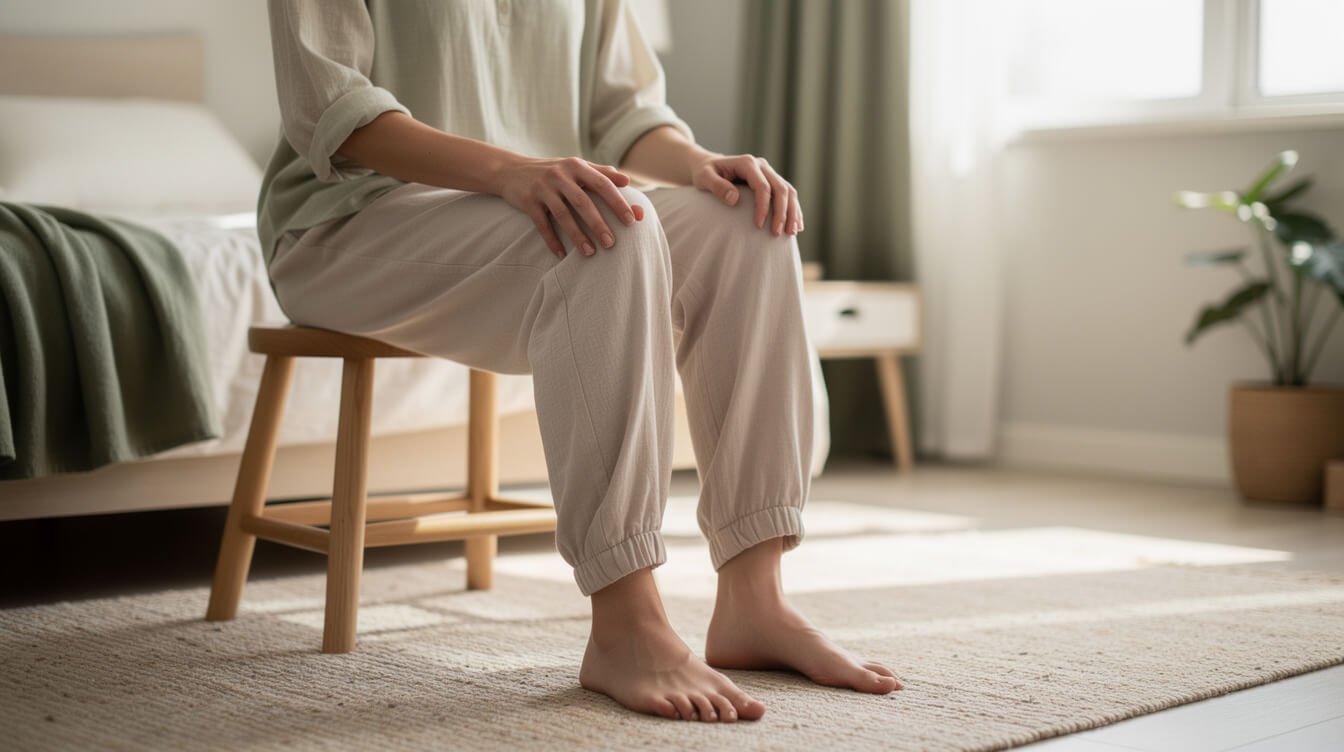
These are the points that show up most often in traditional practice and in the studies above. You don’t need all eight. Pick three or four that feel good and are easy for you to reach.
1. Tianshu (ST25), “Heavenly Pivot”
Where: 2 cun (three finger widths) to the left and right of your belly button, level with it.
How: Lie on your back with your knees bent. Place two or three fingertips on each point and sink in gently on an out-breath. Make slow circles for 1–2 minutes.
Why it’s used: ST25 is probably the most important traditional point for bowel function. It’s a core point in acupuncture research on constipation, and it was one of the three points used in the hospice study by Wang and colleagues.
2. Qihai (CV6), “Sea of Energy”
Where: 1.5 cun (two finger widths) straight below your belly button, on the midline.
How: Rest two or three fingers on the point and press gently in slow circles for 1–2 minutes. This area can be sensitive, so keep it light.
Why it’s used: Traditionally used for bloating, sluggishness, and low energy in the lower belly.
3. Zhongwan (CV12), “Middle Cavity”
Where: on the midline, halfway between your belly button and the bottom tip of your breastbone (about 4 cun above the navel).
How: Gentle, slow circles with flat fingers for 1 minute. Avoid it right after a large meal.
Why it’s used: A classic “stomach” point in TCM, used for fullness and indigestion. It was paired with ST25 and CV4 in the Wang 2019 study.
4. Zusanli (ST36), “Leg Three Miles”
Where: 3 cun (four finger widths) below the lower edge of your kneecap, and one thumb width toward the outside of your shinbone. Flex your foot up and down and you’ll feel a muscle move under your fingers.
How: Sit with your knee bent. Press firmly with your thumb in small circles for 1–2 minutes on each leg.
Why it’s used: ST36 is one of the most widely used points in all of acupressure, traditionally linked to digestion and overall vitality.
5. Zhigou (TE6, also written SJ6), “Branch Ditch”
Where: on the back of your forearm, 3 cun (four finger widths) above the wrist crease, in the groove between the two forearm bones.
How: Press firmly with your thumb for 1–2 minutes on each arm. It’s easy to do at a desk or on a plane.
Why it’s used: TE6 is the classic “constipation point” of traditional practice. In the Kirca 2021 randomized trial, pregnant women who pressed TE6 for 15 minutes twice a day for one week reported less severe constipation than the control group.
6. Sanyinjiao (SP6), “Three Yin Meeting”
Where: 3 cun (four finger widths) above the tip of your inner ankle bone, just behind the edge of the shinbone.
How: Firm thumb pressure for 1 minute on each leg. It’s often tender.
Why it’s used: Traditionally used for digestion and lower-belly comfort. Avoid this point during pregnancy, as it’s traditionally avoided in TCM.
7. Hegu (LI4), “Joining Valley”
Where: in the web between your thumb and index finger, at the highest point of the muscle when you press them together.
How: Pinch the web with the thumb and index finger of your other hand and press toward the bone of the index finger for 1 minute per hand. Our guide to acupressure points on hand walks through LI4 in detail.
Why it’s used: LI4 is the “source point” of the Large Intestine channel in TCM. Avoid it during pregnancy.
8. The perineal point (the one most guides skip)
Where: the perineum, the soft area between the anus and the genitals.
How: When you feel the urge and are sitting on the toilet, press firmly with two fingers (over clothing or toilet tissue if you prefer) in slow pulses toward the rectum for a few minutes.
Why it’s used: This is the technique tested in the UCLA trial by Abbott and colleagues. Of the 100 adults with functional constipation, those taught perineal self-acupressure reported clearly better bowel function and quality of life after four weeks than those given standard advice alone. It may feel unusual, but it’s private, takes seconds, and has more direct trial support than most of the points above. Skip it if you have painful hemorrhoids, a fissure, or recent surgery in that area.
Quick-start set: If you only learn three, choose Tianshu (ST25) for the belly, Zhigou (TE6) for the arm, and Zusanli (ST36) for the leg. Together they take about five minutes.
Abdominal Massage: The Best-Studied Hands-On Approach

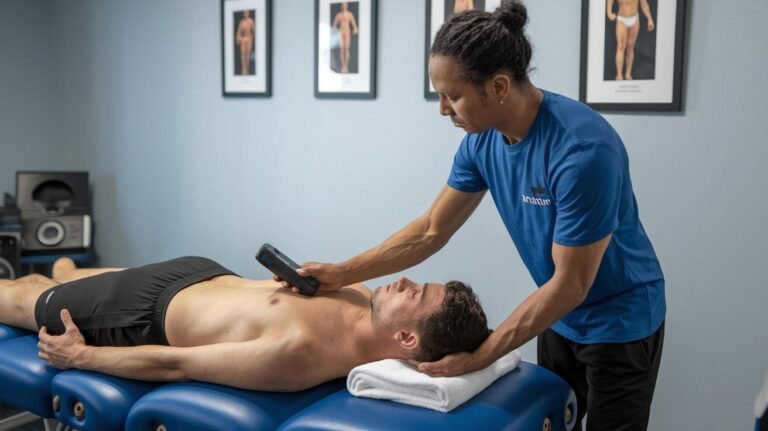
If you only have time for one thing, make it this. Abdominal massage has the strongest research behind it of any self-care technique for constipation. The 2025 meta-analysis by Huang and colleagues pooled 23 studies and found it added about 1.6 bowel movements per week, shortened gut transit time, and eased constipation symptoms compared with control groups. A 2026 review of 35 studies found similar benefits for both hand massage and device-assisted massage.
In the Swedish trial by Lämås and colleagues, 60 people with constipation who added abdominal massage to their usual laxatives had fewer symptoms and more frequent bowel movements after eight weeks. Notably, they didn’t use fewer laxatives. The researchers concluded that massage is best seen as a complement to your current plan, not a substitute. Never stop a prescribed medication without talking to your provider.
The clockwise “colon map” massage
The idea is to follow the path of your large intestine, which runs up the right side of your belly, across the top, and down the left side. Massaging in that direction follows the natural flow.
- Get comfortable. Lie on your back with a pillow under your knees. Warm your hands, and use a little oil or lotion if you like.
- Warm up (1 minute). Place your palms flat on your belly and make large, slow clockwise circles around the belly button.
- Up the right side (1 minute). Starting just inside your right hip bone, use flat fingers to stroke slowly upward toward your ribs.
- Across the top (1 minute). Stroke from under your right ribs across to under your left ribs.
- Down the left side (1 minute). Stroke from under your left ribs down toward your left hip bone. This last stretch leads toward the end of the colon, so give it a little extra attention.
- Finish (1–2 minutes). Return to slow clockwise circles, then press Tianshu (ST25) on both sides for 30 seconds each.
Use moderate, comfortable pressure, enough to move the skin and the soft tissue under it, never enough to hurt. Breathe slowly into your belly as you go. If you’d like to go a step further, some people enjoy gentle foot work too; our guide to reflexology benefits covers the traditional foot maps.
A Gentle 10-Minute Morning Routine for Acupressure Points Constipation Relief
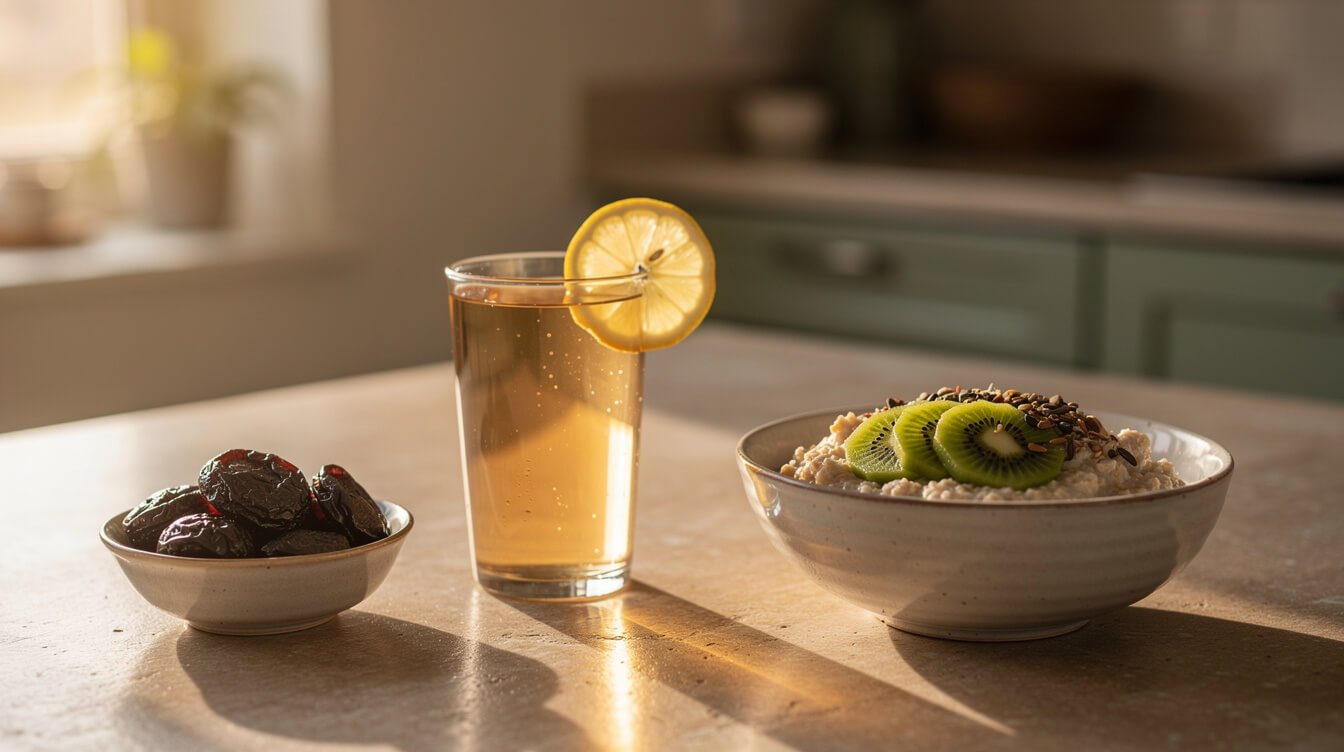
Timing is your secret weapon. Your colon is naturally most active in the morning, after you wake and especially after you eat or drink something warm. This “gastrocolic reflex” is your body’s built-in cue to go. A short routine that lines up with it often works better than random sessions through the day.
| Time | Step | Why |
|---|---|---|
| Minute 0 | Drink a large glass of warm water or herbal tea as soon as you get up. | Fluid plus warmth helps wake up the gut. |
| Minutes 1–4 | Abdominal massage (the clockwise sequence above), lying in bed or on the sofa. | The best-studied hands-on technique. |
| Minutes 4–6 | Press Tianshu (ST25) and Qihai (CV6) with slow breathing. | Traditional bowel points, plus “rest and digest” breathing. |
| Minutes 6–8 | Sit up and press Zusanli (ST36) on each leg, then Zhigou (TE6) on each arm. | Easy limb points you can reach seated. |
| Minutes 8–10 | Eat a fiber-rich breakfast (for example, oats with two kiwifruit or a few prunes), then head to the bathroom when you feel the urge. Don’t rush. | Food triggers the gastrocolic reflex; fruit has trial support (see below). |
On the toilet, rest your feet on a small stool so your knees sit higher than your hips, lean forward slightly with your elbows on your thighs, and breathe out slowly rather than straining. If things are slow, this is the moment for the perineal technique described above.
Try to do your routine at roughly the same time each day, even on weekends. Regularity loves regularity, and that’s especially true this week as everyone’s body clock adjusts to the time change.
🎁 Get a Free Wellness Gift
Enter your name and email below to receive a special wellness gift from OlyLife — absolutely free!
Pair Acupressure With the Basics: Fiber, Fluids, Movement, and Posture

Acupressure points for constipation work best as one part of a bigger picture. Chronic constipation affects about 14% of adults worldwide, according to a meta-analysis of more than 260,000 people, and it’s roughly twice as common in women. For most people, the foundation looks like this.
Fiber, gradually
A 2022 meta-analysis in the American Journal of Clinical Nutrition found that 66% of people responded to fiber supplements compared with 41% on control treatments. The benefit showed up mainly at doses above 10 grams a day, taken for at least four weeks, with psyllium having the strongest evidence. Increase fiber slowly over a couple of weeks to keep gas and bloating down. Our fiber FAQ has easy autumn sources.
Fruit that pulls its weight
- Kiwifruit: In an international randomized trial (Gearry 2023), eating two green kiwifruit a day for four weeks increased complete bowel movements by about 1.5 per week in people with functional constipation and improved digestive comfort.
- Prunes: In a small trial of 40 adults (Attaluri 2011), dried plums improved bowel movement frequency and stool consistency more than psyllium.
- Rye bread: A 2024 review found rye bread led to more frequent bowel movements than white bread.
Fluids that keep fiber working
Fiber needs water to do its job. In an Italian trial (Anti 1998), adults eating 25 grams of fiber a day had more frequent bowel movements and used fewer laxatives when they also drank 1.5–2 liters of fluid daily. The same 2024 review found that mineral-rich water helped more people than low-mineral water. Keeping a bottle within reach is the simplest trick. Some people in our community enjoy the OlyLife H+ Molecular Hydrogen Infusing Water Bottle as a nudge to keep sipping through the day. Whatever you use, steady hydration is the goal, especially as you add fiber.
Movement
A meta-analysis of nine randomized trials (Gao 2019, 680 people) found that exercise, mostly walking, qigong, and other aerobic activity, roughly doubled the chance of constipation improving, though the studies had a high risk of bias. Even a 10–15 minute stroll after meals can help. Our post-meal walk tip explains why.
Toilet posture
In a study of 52 people (Modi 2019), using a footstool to raise the knees reduced straining, shortened time on the toilet, and increased the feeling of complete emptying. It’s one of the cheapest changes you can make.
Calm and routine
Stress, rushing, and ignoring the urge all slow things down. The breathing you do during acupressure is part of the benefit. For more on that connection, see our short read on the gut-brain connection.
Make Your Evening Wind-Down Something to Look Forward To ✨
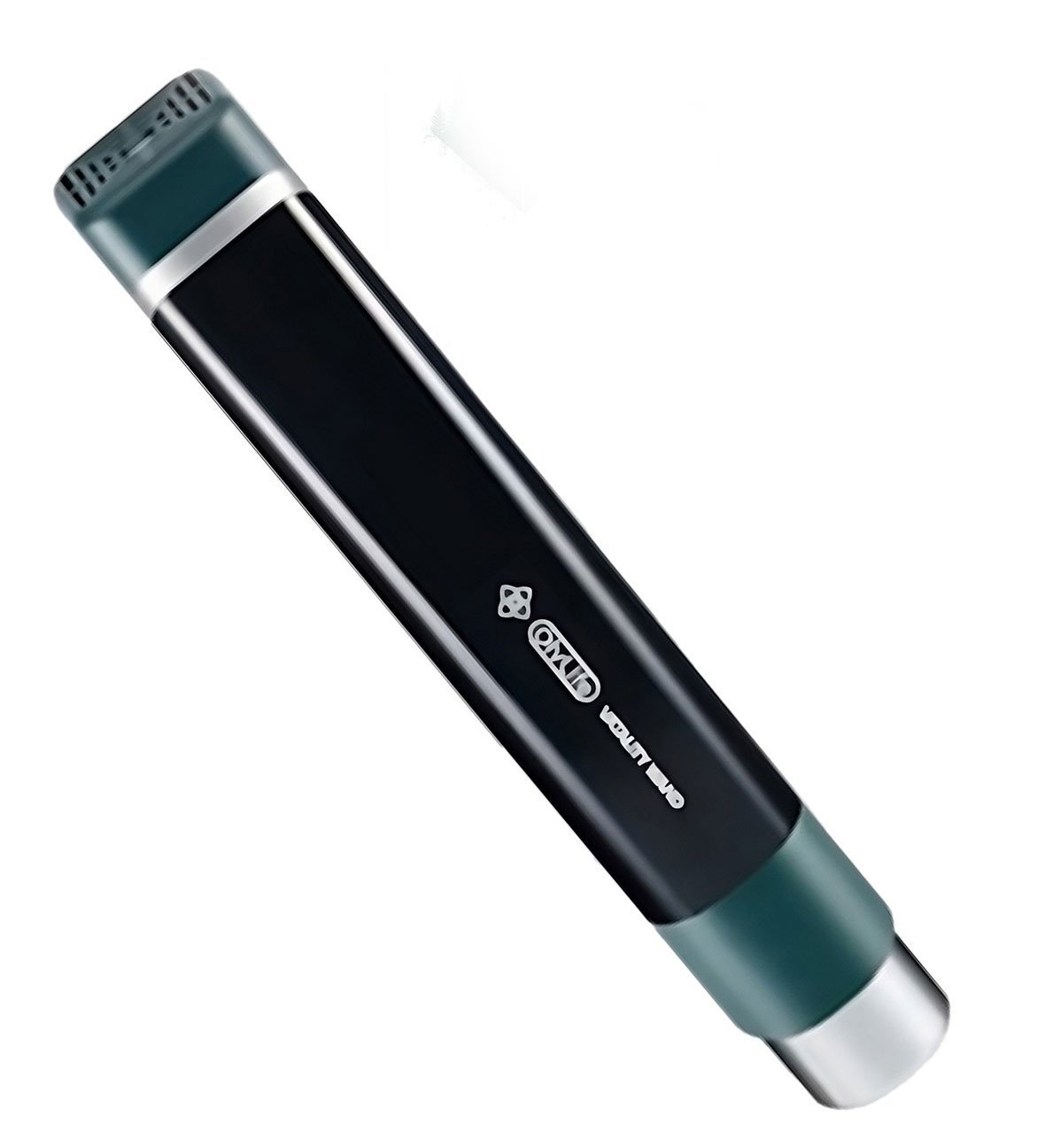
A calm body digests more comfortably. The OlyLife Vitality Wand is a handheld terahertz and PEMF wellness device that many customers enjoy as part of a relaxing evening routine, alongside gentle stretching and slow breathing. It’s designed to support relaxation and general wellbeing, not to diagnose, treat, or relieve constipation or any other condition.
Safety First: Who Should Be Careful, and When to See a Doctor

Acupressure and gentle abdominal massage are low-risk for most adults, and the studies above reported few, if any, side effects. Still, a few situations call for extra care.
| Situation | What to do |
|---|---|
| Pregnancy | Avoid LI4 and SP6, which are traditionally avoided in pregnancy, and skip deep belly pressure. TE6 was used safely in a pregnancy trial, but check with your midwife or doctor before starting any acupressure. |
| Recent abdominal surgery, hernia, or a known abdominal aortic aneurysm | Don’t press or massage the belly. Limb points only, and only with your doctor’s OK. |
| Inflammatory bowel disease, diverticulitis, or unexplained belly pain | Skip abdominal pressure during flares or while pain is undiagnosed. Talk to your provider first. |
| Blood thinners or bleeding disorders | Use light pressure only, since firm pressure can bruise. |
| Painful hemorrhoids or an anal fissure | Skip the perineal technique until things have healed. |
| Broken skin, rashes, or varicose veins over a point | Choose a different point. |
Check your medicine cabinet
Many common medications can cause constipation, including opioid pain relievers, iron and calcium supplements, some antidepressants, some blood pressure medicines, and antacids containing aluminum. If your constipation started after a new prescription, ask your pharmacist or doctor. Don’t stop any medication on your own.
When to get medical advice promptly
Please don’t rely on self-care if you notice any of these:
- Blood in your stool, or black, tarry stools
- Unexplained weight loss, ongoing fatigue, or signs of anemia
- Severe or worsening belly pain, a swollen belly, vomiting, or being unable to pass gas
- A new, lasting change in your bowel habits, especially if you’re over 45 or have a family history of bowel cancer
- Constipation that lasts more than about three weeks despite good habits
- Fever along with abdominal pain
These don’t always mean something serious, but they deserve a proper check. For more on what your gut may be telling you, read our guide to the signs of poor gut health, and if cramping is the bigger issue, see natural relief for stomach pain.
Frequently Asked Questions About Acupressure Points for Constipation
How quickly does acupressure work for constipation?
Some people notice an urge within minutes of abdominal massage, especially in the morning. For lasting change, most studies ran one to eight weeks, so give a daily routine at least two to four weeks before deciding whether it’s helping.
Which single point is best for constipation?
There’s no proven “best” point. Tianshu (ST25) has the most traditional and research support among body points, and Zhigou (TE6) is the classic constipation point that’s easy to reach anywhere. Overall, clockwise abdominal massage has the strongest evidence of any hands-on technique.
Can I use acupressure instead of laxatives?
Think of acupressure as a complement, not a replacement. In the Lämås trial, people who added abdominal massage felt better but didn’t use fewer laxatives. If you take laxatives regularly or were prescribed them, talk with your provider before changing anything.
Is acupressure for constipation safe during pregnancy?
One randomized trial found that pregnant women who pressed TE6 twice a day had less severe constipation. However, LI4 and SP6 are traditionally avoided in pregnancy, and deep belly pressure isn’t advised. Always check with your midwife or doctor first.
Can acupressure help kids with constipation?
Gentle tummy massage is commonly used with children, but constipation in kids deserves a conversation with their pediatrician first, especially if it’s ongoing, painful, or comes with other symptoms.
Does acupressure help with bloating and gas, too?
Many of the same points, especially Tianshu (ST25), Qihai (CV6), and Zhongwan (CV12), are traditionally used for bloating and fullness. The research on bloating specifically is limited, but the slow breathing and gentle massage are relaxing either way.
Do I need an acupuncturist, or can I do this myself?
Everything in this guide is designed for self-care at home. If you’d like more personal guidance, or want to explore ear acupressure or acupuncture (which have their own research), a licensed acupuncturist can tailor a plan for you.
Final Thoughts: Small, Steady Steps Toward Regularity
Constipation is common, uncomfortable, and often a little embarrassing to talk about, but you have more gentle tools than you might think. Acupressure points for constipation, especially Tianshu, Zhigou, and Zusanli, plus a few minutes of clockwise abdominal massage, give you a calm, hands-on way to support your body’s natural rhythm. The research is still young for individual points, and it’s strongest for belly massage. That’s exactly why the best approach is a routine: warm water on waking, a few minutes of massage and pressure, a fiber-rich breakfast, a footstool, a daily walk, and time to relax.
Start small this week. Pick three points, learn the massage, and attach them to something you already do every morning. Notice how you feel after two weeks, and be kind to yourself on the days your body has other plans. And if anything on the warning-sign list shows up, let your doctor be part of the plan. ✨
Want to keep building your self-care toolkit? Explore our sinus acupressure point guide for cold and flu season, too.
References
- Huang SY, et al. Effectiveness of abdominal massage on chronic constipation in adults: a systematic review and meta-analysis. Int J Nurs Stud. 2025. PMID 39531948
- Delgado ME, et al. Safety and efficacy of manual and automated abdominal colonic massage for chronic constipation: a systematic review and meta-analysis. Clin Transl Gastroenterol. 2026. PMID 41919979
- Lämås K, et al. Effects of abdominal massage in management of constipation: a randomized controlled trial. Int J Nurs Stud. 2009. PMID 19217105
- Abbott R, et al. Effect of perineal self-acupressure on constipation: a randomized controlled trial. J Gen Intern Med. 2015. PMID 25403522
- Abbasi P, et al. Effect of acupressure on constipation in patients undergoing hemodialysis: a randomized double-blind controlled clinical trial. Avicenna J Phytomed. 2019. PMID 30788281
- Kirca AŞ, Kanza Gül D. Effects of self-acupressure on pregnancy-related constipation: a single-blind randomized controlled study. Explore (NY). 2021. PMID 32782111
- Wang PM, et al. Effect of acupressure on constipation in patients with advanced cancer. Support Care Cancer. 2019. PMID 30675666
- Jiang ZF, et al. Auricular acupressure for constipation in adults: a systematic review and meta-analysis. Front Physiol. 2023. PMID 37908337
- Liu Z, et al. Acupuncture for chronic severe functional constipation: a randomized trial. Ann Intern Med. 2016. PMID 27618593
- Suares NC, Ford AC. Prevalence of, and risk factors for, chronic idiopathic constipation in the community: systematic review and meta-analysis. Am J Gastroenterol. 2011. PMID 21606976
- van der Schoot A, et al. The effect of fiber supplementation on chronic constipation in adults: an updated systematic review and meta-analysis of randomized controlled trials. Am J Clin Nutr. 2022. PMID 35816465
- van der Schoot A, et al. Systematic review and meta-analysis: foods, drinks and diets and their effect on chronic constipation in adults. Aliment Pharmacol Ther. 2024. PMID 37905980
- Gearry R, et al. Consumption of 2 green kiwifruits daily improves constipation and abdominal comfort: results of an international multicenter randomized controlled trial. Am J Gastroenterol. 2023. PMID 36537785
- Attaluri A, et al. Randomised clinical trial: dried plums (prunes) vs. psyllium for constipation. Aliment Pharmacol Ther. 2011. PMID 21323688
- Anti M, et al. Water supplementation enhances the effect of high-fiber diet on stool frequency and laxative consumption in adult patients with functional constipation. Hepatogastroenterology. 1998. PMID 9684123
- Gao R, et al. Exercise therapy in patients with constipation: a systematic review and meta-analysis of randomized controlled trials. Scand J Gastroenterol. 2019. PMID 30843436
- Modi RM, et al. Implementation of a defecation posture modification device: impact on bowel movement patterns in healthy subjects. J Clin Gastroenterol. 2019. PMID 30346317