Acupressure Points on Hand: 8 Traditional Points, What Research Suggests, and a 5-Minute Routine
Your hands go everywhere with you: to the desk, the kitchen, the car, the airplane seat, and the edge of the bed when sleep won’t come. That makes them one of the most convenient places to practice a little self-care. Acupressure points on hand are specific spots on your palms, fingers, and wrists that traditional Chinese medicine has mapped for centuries, and you can reach every one of them without lying down, undressing, or buying anything.
Most guides list a handful of points, say what each one “is believed” to do, and stop there. This one goes further. You’ll learn exactly where to find eight traditional hand and wrist points (with simple finger-width measurements), how firmly and how long to press, what research actually suggests for each one, a five-minute routine you can do anywhere, and the safety notes nobody else seems to mention.
With the clocks falling back this weekend and holiday travel just around the corner, it’s a good moment to learn a few points for winding down at night and staying comfortable on the road. 🌿
A gentle note: This article is for general education and isn’t medical advice. Acupressure is a complementary self-care practice, not a replacement for diagnosis or treatment. If you have a health condition, are pregnant, or have ongoing symptoms, please talk with your healthcare provider.
What Are Acupressure Points on Hand?

Acupressure is the needle-free cousin of acupuncture. Both come from traditional Chinese medicine (TCM), which describes a network of channels, called meridians, that carry qi (vital energy) through the body. Along these channels sit hundreds of acupoints. In acupuncture, a practitioner inserts fine needles at these points. In acupressure, you use steady pressure from your fingers or thumbs instead.
Six of the twelve main meridians begin or end in the hands and fingers: the Lung, Large Intestine, Heart, Small Intestine, Pericardium, and Triple Energizer (also called San Jiao) channels. That’s one reason the hands and wrists are so rich in traditional points. Each point has a code made of the meridian’s initials and a number, so LI4 is the fourth point on the Large Intestine channel, and PC6 is the sixth point on the Pericardium channel. Each also has a poetic Chinese name, such as Hegu (“Joining Valley”) or Shenmen (“Spirit Gate”).
How Western science thinks about it
Modern researchers don’t need to accept the qi model to study acupressure. They test whether pressing a specific point changes a measurable outcome, such as nausea, sleep quality, or anxiety scores, compared with pressing a “sham” spot nearby. Proposed mechanisms include:
- Nerve signaling. Several hand and wrist points sit over or near major nerves (the median nerve runs right under PC6), so pressure may send signals up the spinal cord that influence nausea, pain processing, or relaxation.
- Muscle and fascia release. Points like LI4 sit in muscles that tighten with gripping, typing, and phone use. Firm pressure can simply ease local tension.
- The relaxation response. Slowing down, breathing, and focusing on a soothing touch can shift your nervous system toward a calmer state, whichever point you choose.
- Expectation. Believing a practice will help is a real effect, and good studies try to account for it with sham controls.
That last point matters. As you’ll see below, some hand points have surprisingly solid research behind them, while others rest mostly on tradition. Knowing the difference helps you use acupressure wisely.
Acupressure vs. hand reflexology
You’ll often see these terms mixed up. Acupressure works on specific points along TCM meridians. Hand reflexology is a separate Western system that maps the whole body onto zones of the palm (for example, “the thumb tip corresponds to the head”). Both involve pressing the hands, but the maps and the evidence are different. This guide focuses on acupressure points.
8 Acupressure Points on Hand and Wrist (and How to Find Them)

Traditional locations are measured in cun, a body-relative unit. The easy version: the width of your own thumb at the knuckle is about 1 cun, and the width of your index, middle, and ring fingers held together is about 2 cun. Because it’s based on your own hand, it scales to your body.
Here’s a quick map of the eight points in this guide:
| Point | Traditional name | Where it is | Traditionally used for |
|---|---|---|---|
| LI4 | Hegu (Joining Valley) | Back of hand, in the web between thumb and index finger | Head and face tension, general aches |
| PC6 | Neiguan (Inner Gate) | Inner forearm, 3 finger-widths above the wrist crease | Nausea, queasy stomach, unease |
| HT7 | Shenmen (Spirit Gate) | Wrist crease, pinky side | Restlessness, sleep, calming the mind |
| SI3 | Houxi (Back Stream) | Outer edge of hand, below the pinky knuckle | Neck and upper-back stiffness |
| PC8 | Laogong (Palace of Toil) | Center of the palm | Mental fatigue, overheating, nervous tension |
| LU10 | Yuji (Fish Border) | Fleshy mound at the base of the thumb | Throat and chest comfort |
| TE3 | Zhongzhu (Middle Islet) | Back of hand, between ring and pinky knuckles | Ear and side-of-head tension |
| TE5 | Waiguan (Outer Gate) | Back of forearm, opposite PC6 | Wrist and arm stiffness, side-of-head tension |
1. LI4 (Hegu): the “Joining Valley”
How to find it: Press your thumb against the side of your index finger. Look for the highest point of the little mound of muscle that pops up in the web between them. Relax your hand, then press at that spot, angling slightly toward the bone of your index finger. It’s often tender, especially if you type or text a lot.
Traditionally used for: LI4 is one of the most famous points in all of TCM. It’s traditionally used for tension in the head, face, jaw, and teeth, and for general aches. In practice, many people simply find it a satisfying spot to release after a day of gripping a mouse or steering wheel.
Important: LI4 is traditionally avoided during pregnancy. See the safety section below.
2. PC6 (Neiguan): the “Inner Gate”
How to find it: Turn your palm up. Place three fingers of your other hand across your wrist, with the edge of the first finger on the wrist crease. PC6 sits just above your third finger, in the center of the forearm, between the two tendons you can feel when you make a fist and flex your wrist slightly.
Traditionally used for: nausea, motion queasiness, and a feeling of unease in the chest. This is the point that travel “sea bands” are designed to press, and it has the strongest research of any point in this guide.
3. HT7 (Shenmen): the “Spirit Gate”
How to find it: Turn your palm up and run a finger down from your pinky to the wrist crease. At the crease, just on the thumb side of the firm tendon on the pinky edge of your wrist, you’ll feel a small hollow. That’s HT7.
Traditionally used for: calming the mind, restlessness, and sleep. It’s the point used most often in sleep and anxiety studies, which makes it a lovely one to learn for bedtime.
4. SI3 (Houxi): the “Back Stream”
How to find it: Make a loose fist. On the outer (pinky) edge of your hand, look for the end of the skin crease just below the pinky knuckle. SI3 sits in the small depression there, where the smooth skin of the palm meets the skin on the back of the hand.
Traditionally used for: stiffness in the neck and upper back, which is why some practitioners suggest pressing it while gently turning your head from side to side.
5. PC8 (Laogong): the “Palace of Toil”
How to find it: Make a gentle fist. The point where the tip of your middle finger lands on your palm is roughly PC8, in the center of the palm between the second and third hand bones.
Traditionally used for: mental fatigue, nervous tension, and a feeling of being “overheated” or wound up. It’s also simply a wonderful spot to massage with lotion at the end of the day.
6. LU10 (Yuji): the “Fish Border”
How to find it: Look at the fleshy pad at the base of your thumb on the palm side. LU10 sits at the midpoint of the thumb’s long bone, right where the paler skin of the palm meets the darker skin on the side of the hand.
Traditionally used for: throat and chest comfort. It’s a popular point in cold and flu season, alongside the face points in our sinus acupressure point guide.
7. TE3 (Zhongzhu): the “Middle Islet”
How to find it: On the back of your hand, find the knuckles of your ring and pinky fingers. Slide your finger back about a thumb-width toward your wrist, into the groove between those two bones.
Traditionally used for: tension around the ears and the sides of the head.
8. TE5 (Waiguan): the “Outer Gate”
How to find it: Turn your hand palm-down. Place three fingers across the back of your wrist, starting at the crease. TE5 sits just above your third finger, in the center of the forearm, between the two forearm bones. It’s directly opposite PC6, so you can press both at once with your thumb and middle finger.
Traditionally used for: wrist and arm stiffness and side-of-head tension.
Tip: Don’t worry about finding acupressure points on hand to the millimeter. Explore the area slowly. Most people notice a spot that feels slightly more tender, achy, or “alive” than the surrounding tissue. That’s usually the one.
How to Press Acupressure Points on Your Hand: Technique, Pressure, and Timing
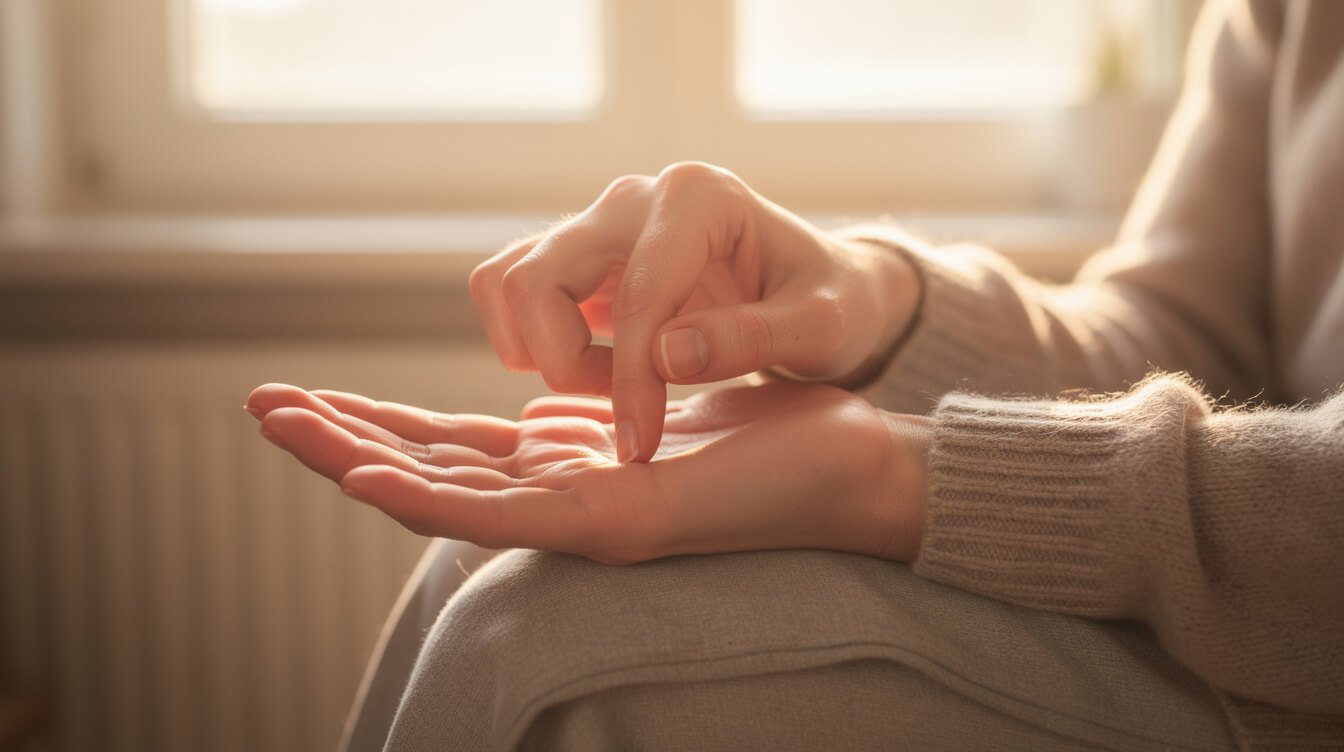
Technique is where most guides get vague (“apply firm pressure”). Here’s something more concrete, drawn from how pressure is applied in research studies.
How firm is “firm”?
A 2018 review of 32 randomized trials on acupressure and sleep found that the standard protocols used about 3 to 5 kg (roughly 6.5 to 11 lb) of pressure for one to five minutes per point, three to seven times a week, for three to four weeks (Waits et al., 2018). That’s firmer than most people expect.
Try this calibration trick: set a kitchen scale on the counter and press the platform with your thumb until it reads 3 to 5 kg. Notice how that feels in your thumb and arm. That’s the pressure range to aim for. The point should feel a strong, achy “good hurt,” not sharp pain. Older adults, people with fragile skin, or anyone on blood thinners should start much lighter.
Step-by-step
- Settle in. Sit comfortably with your shoulders relaxed. Rest the hand you’re working on in your lap or on a table.
- Find the point. Use the landmarks above and explore for the tender spot.
- Press gradually. Use the pad of your thumb (or the tip of your middle finger for wrist points). Increase pressure slowly over a few seconds.
- Hold or circle. Either hold steady pressure, or make small, slow circles without sliding over the skin.
- Breathe. Take slow breaths in through your nose and longer breaths out. Many people find a 4-count inhale and 6-count exhale relaxing.
- Time it. Aim for 1 to 3 minutes per point. Studies often use up to 5 minutes.
- Release slowly, then repeat on the other hand. Most points are worked on both sides.
Helpful extras
- Warm your hands first. Rub your palms together for 20 seconds or wash them in warm water. Cold, stiff hands are harder to work on.
- Trim your nails. Press with the pad of your thumb, not the nail.
- Use a tool if your thumbs tire. The rounded end of a pen, a smooth massage stick, or a small ball can take the strain off arthritic or tired thumbs.
- Be consistent. The studies with positive results usually used daily or near-daily practice for several weeks. One session is a nice moment of calm, but a habit is where any benefit is more likely to show up.
What Research Suggests About Hand Acupressure Points

Here’s an honest look at the evidence. Some of it is encouraging. Some of it is thin. All of it comes with caveats, because it’s hard to run a truly “blind” acupressure study when people can feel where they’re being pressed.
| Point / use | What studies found | Evidence strength |
|---|---|---|
| PC6 for nausea after surgery | Large Cochrane reviews of dozens of trials found PC6 stimulation reduced nausea and vomiting compared with sham | Moderate-to-low (many trials, mixed quality) |
| PC6 for motion sickness | A controlled lab study found neither wristbands nor placebo prevented motion sickness | Limited / mixed |
| PC6 for pregnancy nausea | Cochrane review found the evidence for wrist acupressure limited and inconsistent | Limited |
| HT7 for sleep | Meta-analysis of acupressure trials (HT7 used most often) found better sleep-quality scores vs sham | Low-to-moderate (promising, risk of bias) |
| HT7 and other points for anxiety | Meta-analyses found less pre-procedure anxiety vs sham | Low-to-moderate |
| LI4 for headache and tension | Mostly studied in combination with other points; small trials, often not hand-only | Limited |
| SI3, PC8, LU10, TE3, TE5 | Little or no point-specific research | Traditional use only |
PC6 and nausea: the best-studied point
PC6 is the standout. A 2015 Cochrane review pooled 59 trials with 7,667 participants undergoing surgery. Compared with sham treatment, PC6 stimulation (including acupressure, wristbands, and needles) reduced the risk of nausea by about a third and reduced vomiting and the need for rescue anti-nausea medication. When PC6 was compared directly with common anti-nausea drugs, the results were similar. The reviewers rated the quality of evidence as low to moderate because of variation between trials (Lee et al., 2015). A 2025 update using newer methods reached a broadly similar conclusion: noninvasive PC6 stimulation may reduce postoperative nausea compared with sham, with low confidence (Lee et al., 2025).
For chemotherapy-related nausea, another Cochrane review found that acupressure may help reduce how bad acute nausea feels, though it didn’t clearly reduce vomiting (Ezzo et al., 2006). If you’re going through cancer treatment, ask your care team before adding anything new, including acupressure bands.
The picture is less clear for motion sickness. In one controlled lab study, people wearing an acupressure band, an electrical stimulation band, or a placebo band all developed motion sickness at similar rates (Miller & Muth, 2004). Some travelers still find PC6 pressure comforting on a winding road, and it’s low-risk to try, but it may not prevent queasiness on its own. And for nausea in early pregnancy, a Cochrane review called the evidence for wrist acupressure “limited” (Matthews et al., 2015).
HT7, sleep, and calm
The sleep review mentioned above (Waits et al., 2018) found that acupressure improved scores on the Pittsburgh Sleep Quality Index by about 3.4 points compared with sham pressure in 385 people across seven trials. That’s a 13 to 19% improvement, with the biggest changes in how quickly people fell asleep and how long they slept. HT7 was the point used most often. No side effects were reported. The main caveat is that blinding people in acupressure trials is difficult.
A small double-blind trial in 40 adults with insomnia found that a wristband pressing HT7 overnight for 20 nights improved sleep quality and anxiety scores more than a placebo band (Nordio & Romanelli, 2008). An older study in 84 nursing-home residents found that an acupressure routine improved sleep quality and reduced night waking more than either sham acupressure or conversation alone (Chen et al., 1999).
For anxiety, a 2015 meta-analysis found that acupressure reduced anxiety before surgery or medical procedures more than sham pressure, with HT7 and the “third eye” point between the eyebrows used most often (Au et al., 2015). A 2023 review of preoperative anxiety trials reached a similar conclusion (Xie et al., 2023).
LI4 and head tension
LI4 is famous, but it’s rarely studied on its own. One small trial in 28 people with chronic headache found that a month of acupressure (using a combination of points) reduced pain scores more than a muscle-relaxant medication, and the difference was still there six months later (Hsieh et al., 2010). That’s encouraging, but it was a small study and didn’t isolate the hand. If you get frequent headaches, our guide to natural pain relief for headache covers the bigger picture, including hydration, sleep, and when to see a doctor.
The honest bottom line
Research suggests that a couple of hand and wrist points, especially PC6 for nausea and HT7 for sleep and calm, may offer modest, real-world support. Other points are best viewed as traditional practices that may feel relaxing but haven’t been tested. Working with acupressure points on hand is low-cost and low-risk for most people, so it’s a reasonable thing to explore, as long as it complements, rather than replaces, proper care.
🎁 Get a Free Wellness Gift
Enter your name and email below to receive a special wellness gift from OlyLife — absolutely free!
A 5-Minute Acupressure Points on Hand Routine

Here’s a simple routine that strings several acupressure points on hand together. It takes about five minutes and works at your desk, on the couch, or in bed.
- Warm up (30 seconds). Rub your palms together briskly, then shake out your hands. Take three slow breaths.
- PC8, center of the palm (45 seconds per hand). Press your thumb into the center of your opposite palm and make slow circles. Let your shoulders drop.
- LI4, the web of the hand (45 seconds per hand). Squeeze the web between thumb and index finger with your opposite thumb on top and index finger underneath. Breathe out slowly as you press.
- SI3, outer edge (30 seconds per hand). Press the outer edge of your hand below the pinky knuckle while slowly turning your head left and right.
- HT7, pinky side of the wrist (45 seconds per hand). Hold steady, gentle pressure. Lengthen your exhale.
- Finish (30 seconds). Gently stretch each finger, then rest your hands palms-up on your thighs for a few breaths.
Three mini-routines for different moments
| Moment | Points | How long | Pair it with |
|---|---|---|---|
| Desk break (after long typing) | LI4, SI3, TE5 | 1 minute each, both hands | Wrist circles and a short walk |
| Bedtime wind-down | HT7, PC8, PC6 | 2 minutes each, both hands | Dim lights, slow breathing, no screens |
| On the road (car, plane, boat) | PC6 | 2–3 minutes per wrist, repeat as needed | Fresh air, looking at the horizon, small sips of water |
The bedtime routine is especially timely this weekend. When the clocks fall back, your body clock can feel off for days. Pairing a few minutes of HT7 and PC8 pressure with the habits in our guide on how to improve sleep quality naturally is a gentle way to help your evenings feel more settled. If shorter days are weighing on your mood too, our winter blues guide has a seven-day plan.
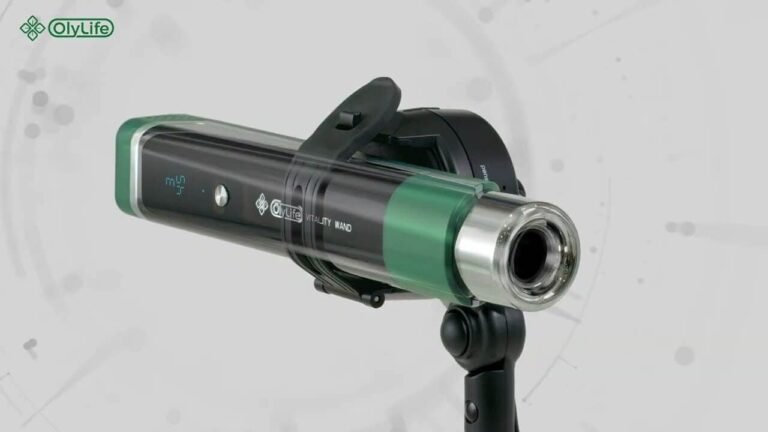
Many people like to extend their evening wind-down beyond the hands. A tennis ball self-massage works well for tight shoulders and feet, and some of our customers enjoy the OlyLife Vitality Wand as a relaxing few minutes for the neck and shoulders after their hand routine. Think of it as part of a calming ritual, not a treatment.
Going further: tools and whole-body acupressure
Once you’re comfortable with your hands, the same principles apply across the body. If you’d like to try pressure over a larger area, our guide on acupressure mats for back pain explains what the research says and how to start gently. And for a wider look at drug-free comfort strategies, see natural therapy for pain.
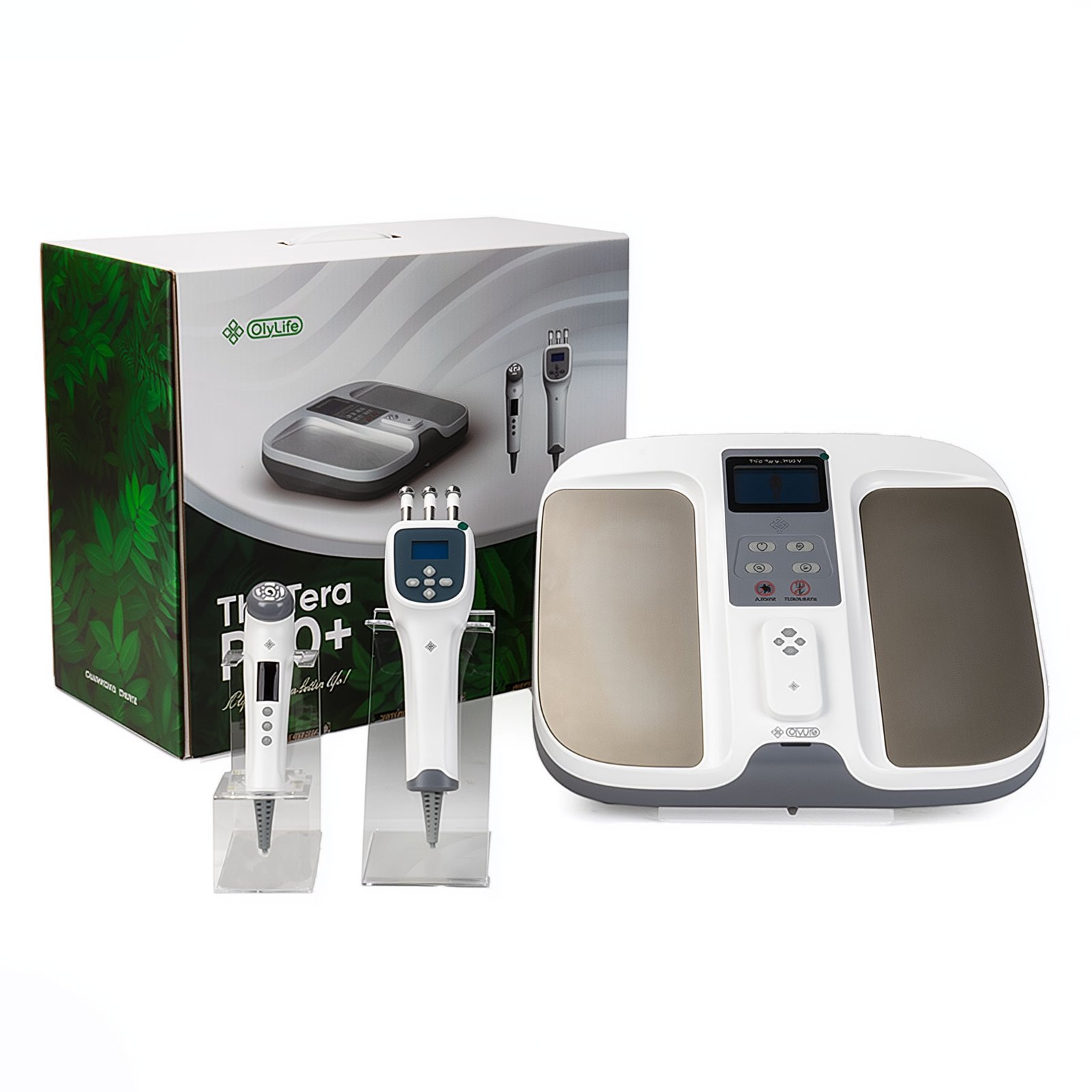
From Hands to Feet: Build a Calming Evening Ritual ✨
Your hands are a wonderful place to start, and your feet deserve some care too. The OlyLife THz Tera-P90+ is an at-home PEMF and terahertz wellness system with a foot device at its heart, which many customers enjoy as a relaxing part of their evening routine. It’s designed to support relaxation, not to diagnose or treat any condition.
Safety First: Who Should Be Careful With Hand Acupressure

Pressing acupressure points on hand is gentle and generally safe for most adults. Reviews of acupressure trials report few, if any, serious side effects. Still, a few situations call for extra care.
| Situation | What to do |
|---|---|
| Pregnancy | LI4 is traditionally avoided during pregnancy in TCM. Talk with your midwife or doctor before using any acupressure, and don’t use it to try to bring on labor. |
| Blood thinners or bleeding disorders | Use light pressure only. Firm pressure can cause bruising. |
| Cuts, burns, rashes, infections, or recent injury | Skip the area until it has fully healed. |
| Arthritis flares, swollen joints, or recent hand or wrist surgery | Avoid pressing swollen or painful joints. Ask your doctor or hand therapist first. |
| Carpal tunnel symptoms | PC6 sits over the median nerve. Use gentle pressure, and stop if tingling or numbness increases. |
| Diabetes or reduced sensation (neuropathy) | You may not feel how hard you’re pressing. Use light pressure and check your skin afterward. |
| Fragile skin (older adults, long-term steroid use) | Use a soft, broad touch rather than a hard thumb or tool. |
When to see a doctor instead
Acupressure should never delay care for symptoms that need attention. Contact a healthcare provider if you have:
- A sudden, severe, or “worst ever” headache, or a headache with fever, stiff neck, confusion, weakness, or vision changes (seek urgent care)
- Nausea or vomiting that lasts more than a day or two, or signs of dehydration
- Ongoing trouble sleeping that affects your daytime life for several weeks
- Anxiety that feels overwhelming or interferes with daily life
- New numbness, tingling, or weakness in your hands
If you ever feel hopeless or have thoughts of harming yourself, please reach out right away. In the US, you can call or text 988 to reach the Suicide & Crisis Lifeline.
Frequently Asked Questions About Acupressure Points on Hand

What are the main acupressure points on the hand?
The most commonly used points are LI4 (Hegu) in the web between the thumb and index finger, PC6 (Neiguan) on the inner forearm, HT7 (Shenmen) at the pinky side of the wrist crease, SI3 (Houxi) on the outer edge of the hand, and PC8 (Laogong) in the center of the palm.
How long should I press an acupressure point?
Most people do well with 1 to 3 minutes per point. Research protocols typically used 1 to 5 minutes per point, three to seven times a week, for several weeks.
How hard should I press?
Firm enough to feel a strong, dull ache, but never sharp pain. Studies often used about 3 to 5 kg (6.5 to 11 lb) of pressure. Try pressing a kitchen scale to get a feel for it, and use lighter pressure if you bruise easily.
Which hand point is used for sleep?
HT7 (Shenmen), at the pinky side of the wrist crease, is the point used most often in sleep studies. Many people combine it with PC8 and PC6 as part of a bedtime wind-down.
Does the wrist point really help with nausea?
PC6 has the strongest research of any hand or wrist point. Large reviews found it may reduce nausea after surgery. Evidence for motion sickness and pregnancy nausea is weaker and mixed, but many people find it comforting to try.
Is it safe to press LI4 while pregnant?
LI4 is traditionally avoided during pregnancy. Please talk with your midwife or doctor before using any acupressure while pregnant.
Should I press one hand or both?
Both. Most traditional points come in pairs, and studies often used both sides. Work on one hand, then switch.
Is hand acupressure the same as hand reflexology?
No. Acupressure targets specific points along TCM meridians. Reflexology is a different system that maps the whole body onto zones of the hands and feet. Both can be relaxing, but they use different maps.
How soon will I notice anything?
Some people feel calmer within a single session. Studies on sleep and anxiety usually looked at results after a few weeks of regular practice, so give it time and notice how you feel.
Final Thoughts: Small Points, Gentle Practice
There’s something quietly empowering about knowing a few acupressure points on hand. You don’t need an appointment, an app, or a single piece of equipment, just a few minutes and a willingness to slow down. Research suggests a couple of these points, especially PC6 and HT7, may offer real, modest support for queasiness, sleep, and calm. The others carry centuries of tradition and, at the very least, give your busy hands a well-earned rest.
Start with one or two points that match what you need most right now. Try the bedtime trio this weekend as the clocks change, or tuck PC6 away for holiday travel. Press with care, breathe slowly, and pay attention to how your body responds. Keep what helps, and let the rest go.
And remember, acupressure is a companion to good care, not a replacement for it. If something doesn’t feel right, check in with your healthcare provider. Here’s to calmer evenings and happier hands. ✨
This article is for educational purposes only and isn’t intended to diagnose, treat, cure, or prevent any disease. Always consult a qualified healthcare provider before starting acupressure if you are pregnant, have a medical condition, or take medication.
Sources
- Lee A, Chan SK, Fan LT. Stimulation of the wrist acupuncture point PC6 for preventing postoperative nausea and vomiting. Cochrane Database Syst Rev. 2015. PMID 26522652
- Lee A, et al. Stimulation of the wrist acupuncture point PC6 for preventing postoperative nausea and vomiting: a network meta-analysis. Cochrane Database Syst Rev. 2025. PMID 40938065
- Ezzo JM, et al. Acupuncture-point stimulation for chemotherapy-induced nausea or vomiting. Cochrane Database Syst Rev. 2006. PMID 16625560
- Miller KE, Muth ER. Efficacy of acupressure and acustimulation bands for the prevention of motion sickness. Aviat Space Environ Med. 2004. PMID 15018290
- Matthews A, et al. Interventions for nausea and vomiting in early pregnancy. Cochrane Database Syst Rev. 2015. PMID 26348534
- Waits A, et al. Acupressure effect on sleep quality: a systematic review and meta-analysis. Sleep Med Rev. 2018. PMID 28089414
- Nordio M, Romanelli F. Efficacy of wrists overnight compression (HT 7 point) on insomniacs: possible role of melatonin? Minerva Med. 2008. PMID 19034253
- Chen ML, et al. The effectiveness of acupressure in improving the quality of sleep of institutionalized residents. J Gerontol A Biol Sci Med Sci. 1999. PMID 10496543
- Au DW, et al. Effects of acupressure on anxiety: a systematic review and meta-analysis. Acupunct Med. 2015. PMID 26002571
- Xie W, et al. Acupressure can reduce preoperative anxiety in adults with elective surgery: a systematic review and meta-analysis of randomised controlled trials. Int J Nurs Stud. 2023. PMID 37321140
- Hsieh LL, et al. Effect of acupressure and trigger points in treating headache: a randomized controlled trial. Am J Chin Med. 2010. PMID 20128040