Nhiệt độ ngâm nước lạnh: Khoảng nhiệt độ phù hợp với mục tiêu của bạn, thời gian ngâm và cách bắt đầu an toàn.
Pick a number. Ask ten people about the right cold plunge temperature and you’ll hear everything from “anything under 70°F” to “just above freezing, or it doesn’t count.” Most of the advice online comes from companies that sell tubs and chillers, so colder tends to sound better. The research tells a calmer story. You don’t need ice-cold water to get the effects people are looking for, and going colder mostly adds risk and discomfort rather than extra benefit.
This guide gives you the temperature ranges in both Fahrenheit and Celsius, what the studies behind those numbers actually tested, a 4-week progression for beginners, how long to stay in at each temperature, how much ice you really need for a home tub, and the safety signs that mean it’s time to get out. If you’re still deciding whether cold plunging is for you at all, start with our companion guide to the benefits of cold plunge and what research suggests, then come back here for the practical numbers.
Cold Plunge Temperature at a Glance
Here’s the short answer: 50–59°F (10–15°C) is the range most research uses and the one most people settle into. Beginners do well starting at the warm end of that range, or even a little above it. Very cold water below 50°F is for experienced plungers, for short dips only. Below about 40°F (4°C), the risks climb and there’s little evidence of extra benefit for home use.
| Zone | Fahrenheit | Celsius | Who it suits | Typical time |
|---|---|---|---|---|
| Mát mẻ | 60–68°F | 15–20°C | First-timers, cold-sensitive people, and anyone easing back in after a break | 2–5 minutes |
| Cold (the research range) | 50–59°F | 10–15°C | Most regular plungers, once the first gasp no longer surprises you | 1–5 minutes |
| Very cold | 40–49°F | 4–9°C | Experienced plungers who are comfortable in the 50s | Từ 30 giây đến 2 phút |
| Extreme | Below 40°F | Below 4°C | Not recommended for home use | Not recommended |
Quick Fahrenheit to Celsius conversions
Tub thermometers and chillers don’t all use the same scale, so here are the numbers you’ll see most often: 68°F = 20°C, 65°F = 18.3°C, 60°F = 15.6°C, 59°F = 15°C, 55°F = 12.8°C, 50°F = 10°C, 45°F = 7.2°C, 40°F = 4.4°C. If you only remember one pair, make it this: 59°F is 15°C, the upper limit that most cold-water studies use.
One thing the table can’t show: the same number feels different from one day to the next. Water that’s moving, a chilly morning, a poor night’s sleep, or a lean body build all make the cold feel stronger. Treat these cold plunge temperature ranges as a starting point and let your body’s response decide the exact number.
What the Research Actually Tested (and Why Colder Isn’t Automatically Better)
Many competing guides quote impressive study numbers without mentioning the water temperature or the time involved. Those details change the picture, so here they are side by side.
| Học | Water and time | Những gì nó tìm thấy | Điều đó có ý nghĩa gì đối với bạn |
|---|---|---|---|
| Machado 2016, meta-analysis of 9 trials | Various, after exercise | For muscle soreness, the best results came from water at 10–15°C (50–59°F) for 10–15 minutes. | The “50–59°F” range has real support, at least for sore muscles after training. |
| Batista 2023, updated meta-analysis of 44 trials | Severe vs. moderate cold, short to long immersions | Cold water beat passive rest for soreness, and the temperature didn’t change the result. Short and medium immersions helped. The longest ones didn’t help with delayed soreness. | Going colder or staying longer doesn’t seem to add much. Moderate is enough. |
| Šrámek 2000 | One hour at 14°C (57°F), head out | Noradrenaline rose about 530% and dopamine about 250%. Metabolic rate rose about 350%. | This famous figure came from a full hour in the water. It isn’t what a 2-minute dip produces, and an hour isn’t safe without lab supervision. |
| Tipton 1991 | 2 minutes at 5, 10 and 15°C | In the first 20 seconds, the gasp and rapid breathing at 10°C (50°F) were as strong as at 5°C (41°F). The colder water just made the response last longer. | Below about 50°F, you don’t get a “bigger” shock, only a longer and riskier one. |
| Cain 2025, meta-analysis of 11 trials (3,177 people) | 7–15°C, 30 seconds to 2 hours | Stress scores were lower 12 hours after cold immersion. Markers of inflammation rose briefly right afterward. | Mood and stress effects may build over the day. The evidence is still thin. |
| Buijze 2016, randomized trial (3,018 people) | 30–90 seconds of cold at the end of a warm shower, for 30 days | 29% fewer self-reported sick days from work, but no fewer days of actually being ill. | Even a cold shower finish may help some people feel more resilient. It isn’t an immunity shield. |
What about the popular “11 minutes of cold per week”? It comes from a small study by Søberg and colleagues that looked at experienced Danish winter swimmers who combined short cold dips with sauna sessions 2–3 times a week. It’s a helpful description of what those swimmers did, but nobody has tested it as a dose. Treat it as a reasonable weekly ballpark, not a target you have to hit.
The big reviews agree on one thing: the evidence is mixed. Professor Mike Tipton’s 2017 review of cold water immersion as both a hazard and a wellness practice concluded that some claims have a credible rationale while others still rest on anecdote. That’s a good mindset to bring to any tub. Cold water is a strong stimulus, and the dose matters more than the drama. If the idea of a small, controlled dose of stress intrigues you, our piece on why a little stress can make you stronger explains the hormesis idea behind it.
Cold Plunge Temperature for Beginners: Start Warmer Than You Think
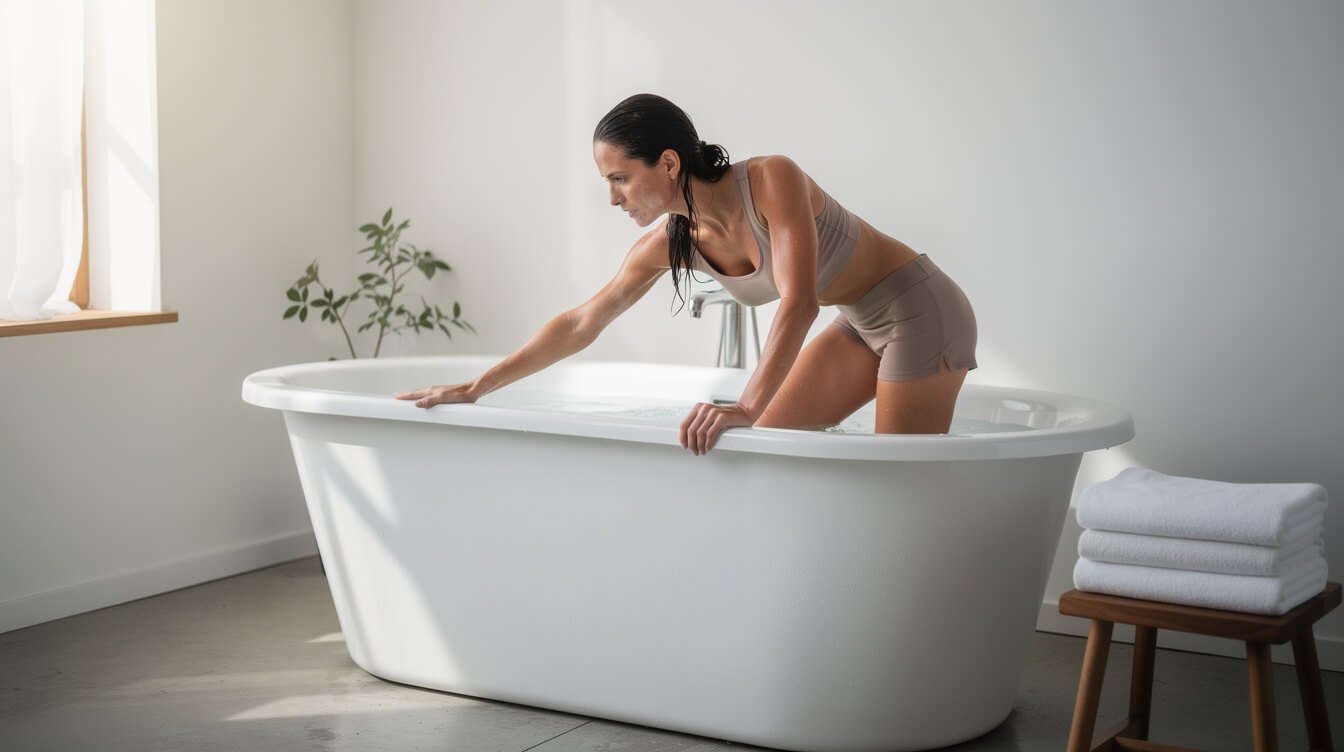
The most useful research for beginners isn’t about benefits at all. It’s about the phản ứng sốc lạnh, the sharp gasp, racing heart and fast, uncontrolled breathing you get in the first 30 seconds to 3 minutes. That response is the main hazard of cold water, and the good news is that it trains down quickly.
In a study by Tipton and colleagues in 1998, people did six 3-minute dips at 15°C (59°F) over a few days. Afterward, when they got into 10°C (50°F) water, their breathing rate in the first 30 seconds dropped from about 47 to 24 breaths per minute, and their heart rate settled faster too. A follow-up study found that much of this adaptation was still there 7 months later. In other words, practicing at a milder temperature prepares you for colder water. You don’t have to start in the deep end.
The mind adapts too. Barwood and colleagues found that simply getting familiar with the immersion routine, even in comfortable water, lowered people’s anxiety going into the cold. Knowing what to expect really does help.
A gentle 4-week progression
| Tuần | Nhiệt độ nước | Time in | Tập trung |
|---|---|---|---|
| 1 | 60–65°F (15–18°C), or a cold finish to your shower | 1–2 minutes (30–60 seconds for showers) | Enter slowly and breathe out long. Let the gasp pass before you settle. |
| 2 | 58–60°F (14–15.5°C) | 2–3 phút | Stay calm through the first 30 seconds. Notice when your breathing slows. |
| 3 | 55–57°F (13–14°C) | 2–3 phút | Lower the temperature, not the time. Change only one thing per week. |
| 4 and beyond | 50–55°F (10–13°C) | 2–5 minutes | Find your steady spot. Many people never go colder, and that’s perfectly fine. |
Two simple rules keep this progression safe. First, change either the temperature or the time, never both at once, and lower the temperature by only 2–3°F at a time. Second, take a step back after illness, travel or a long break. You keep much of your adaptation for months, but your comfort with the cold fades faster.
If you’re starting with showers, know that a cold finish is gentler than full immersion. In one study by Eglin and Tipton, only showers at about 10°C (50°F) reduced the later gasp response, while 15°C (59°F) showers didn’t. Cold tap water often isn’t that cold, so a shower finish is a great habit but not a full substitute for a tub. Our Câu hỏi thường gặp về liệu pháp nước lạnh covers the shower route in more detail.
How Long to Stay In at Each Temperature
Cold plunge temperature and time work together. A colder plunge needs a shorter stay, and a milder one can be longer. For general wellness at home, these ranges are a sensible guide:
| Nhiệt độ nước | Người mới bắt đầu | Regular plunger |
|---|---|---|
| 60–68°F (15–20°C) | 1–3 minutes | 3–5 phút |
| 55–59°F (13–15°C) | 1–2 phút | 2–5 minutes |
| 50–54°F (10–12°C) | Từ 30 giây đến 2 phút | 2–4 phút |
| 45–49°F (7–9°C) | Not yet | 1–2 phút |
| Below 45°F (7°C) | Not recommended | 30 seconds to 1 minute, with a partner present |
You may notice that these times are shorter than the 10–15 minutes in some soreness studies. Those were supervised trials with athletes after hard exercise. For a home routine, the 2023 review found that short and medium dips gave the benefit and the longest ones didn’t. There’s no prize for endurance. The first couple of minutes are where most of the “reset” feeling happens, once your breathing settles.
Signs you’ve had enough for today
- Your fingers are getting clumsy, or you can’t easily touch your thumb to your little finger.
- You start shivering hard while you’re still in the water.
- The calm, alert feeling turns into dread, or you’re simply counting the seconds.
Any of these means it’s time to get out, even if your timer says otherwise. Finishing one minute early is always fine.
How to Measure and Reach Your Target Temperature at Home
Most of the confusion about cold plunge temperature comes from guessing. A cheap, reliable thermometer clears it up.
Measure it properly
- Use a floating pool thermometer or a waterproof digital probe. Don’t rely on how the water feels on your hand. After a few seconds in cold water, skin is a poor judge.
- Stir first, then measure at mid-depth. Ice-cooled water layers, so the top can be several degrees colder or warmer than the water around your chest.
- Double-check chiller readouts. Built-in displays can drift. Compare yours with a separate thermometer once in a while.
Why moving water feels colder
When you sit still, your body warms a very thin layer of water against your skin, which works like a faint blanket. Stirring, jets or a lake current keep sweeping that layer away, so 55°F moving water feels colder than 55°F still water. It’s the water version of wind chill. If your tub has circulation, set your cold plunge temperature a couple of degrees warmer than you would for still water.
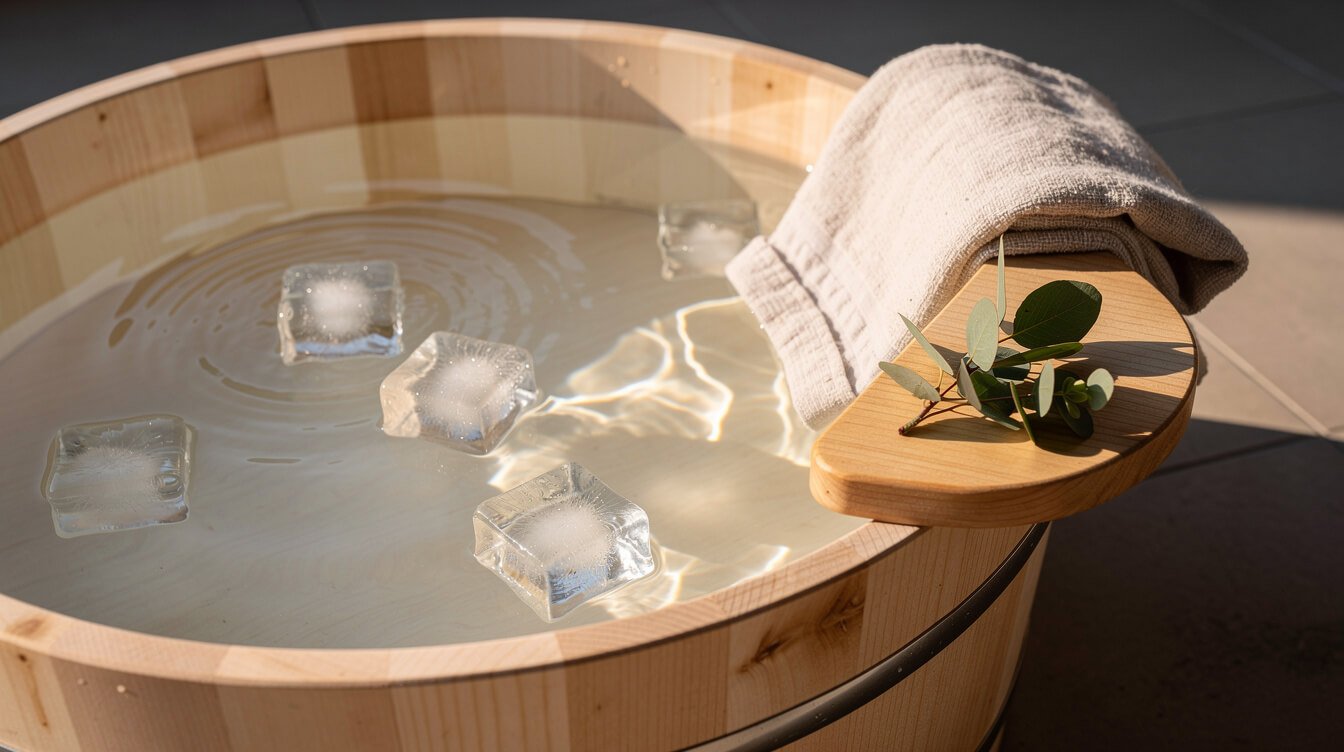
How much ice do you need?
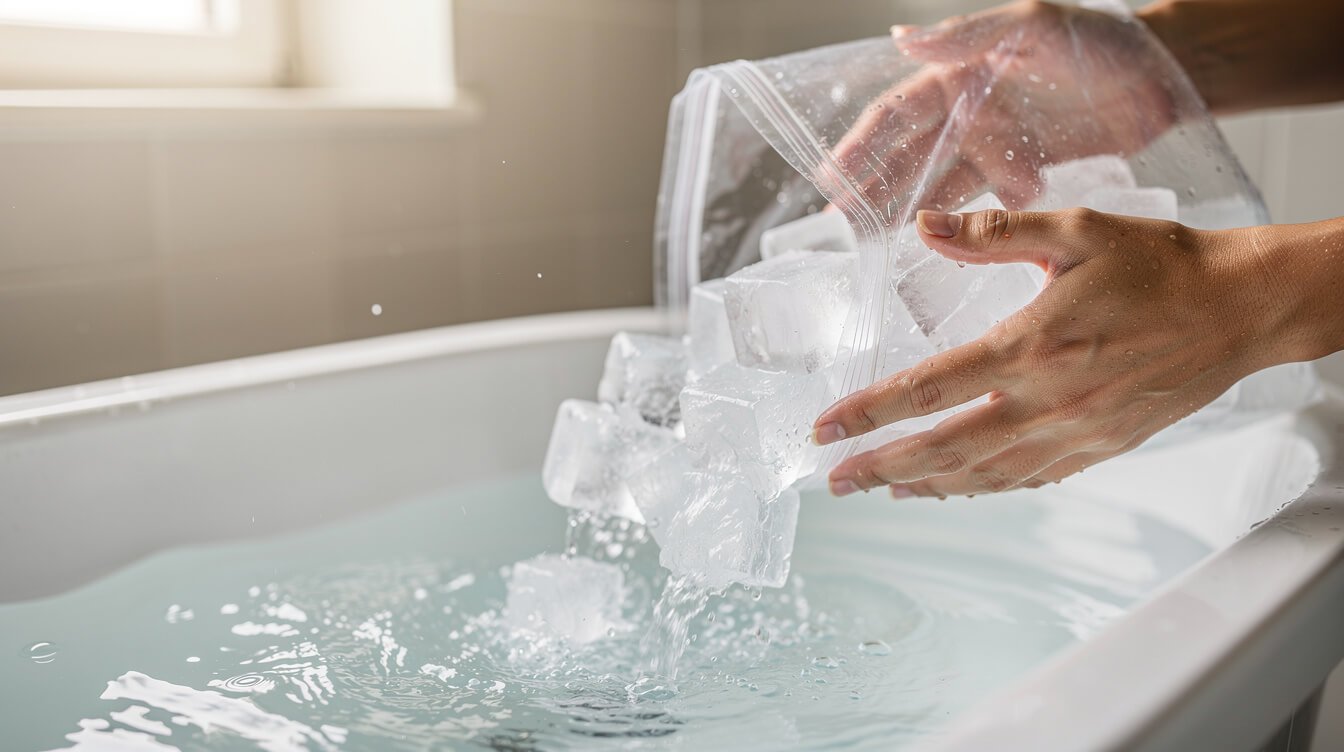
Here’s a handy rule from basic physics: you need about half a pound of ice per gallon of water for every 10°F you want to drop, before you account for heat seeping back in. In real life, the tub walls, room air and your own body heat all warm the water, so plan to buy 1.5 to 2 times the amounts below.
| Water volume | 60°F → 55°F | 60°F → 50°F | 65°F → 55°F |
|---|---|---|---|
| 40 gallons (a standard bathtub, filled to cover you) | about 10 lb | about 20 lb | about 20 lb |
| 80 gallons (a stock tank or large barrel) | about 20 lb | about 40 lb | about 40 lb |
| 100 gallons (a large tub or chest-freezer conversion) | about 25 lb | about 50 lb | about 50 lb |
These are theoretical estimates for bagged ice straight from the freezer, before any heat comes back in.
Start with your coldest tap water, since its temperature varies a lot with the season and where you live. In a northern winter it can be in the 40s°F, while in a southern summer it can sit in the 70s. Add ice gradually, stir, wait a minute and measure again. A cooler of ice kept beside the tub lets you fine-tune between dips. If you plunge often, a dedicated tub with a lid and insulation keeps the temperature far more steady. Our cold plunge benefits guide compares the home options.
Outdoor water is a different animal
There’s no thermostat outdoors, so the cold plunge temperature is whatever nature gives you. Lakes and the sea in late autumn or winter can easily sit in the 40s or low 50s°F, and they move. There’s also no tub edge to hold on to, which matters when the gasp response hits. If you swim or dip outdoors, go with a group, stay close to the shore, enter slowly, and pick a spot where you can easily stand and get out.
🎁 Nhận quà tặng chăm sóc sức khỏe miễn phí
Hãy nhập tên và email của bạn bên dưới để nhận quà tặng chăm sóc sức khỏe đặc biệt từ OlyLife — hoàn toàn miễn phí!
Rewarming and the Afterdrop: The Part Most Guides Skip
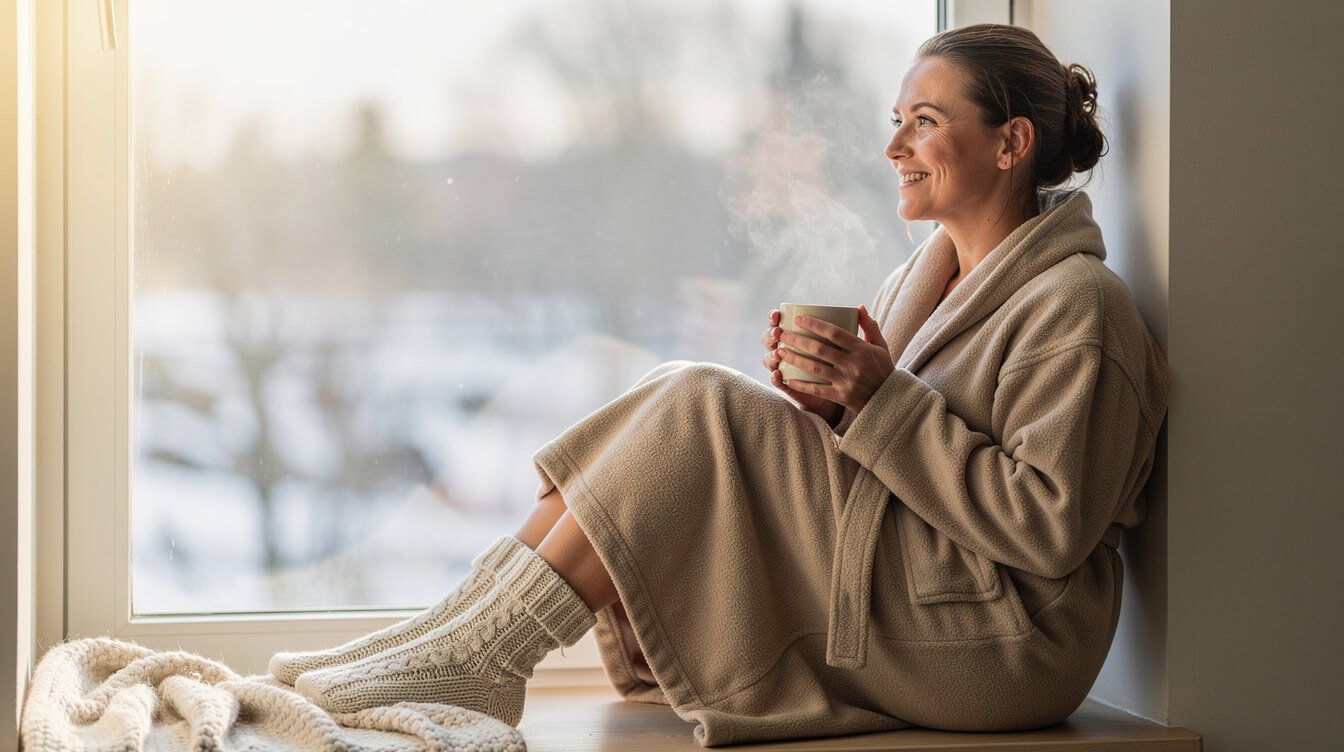
Getting out isn’t the end of the cold. For several minutes after you leave the water, your core temperature can keep falling. This is called the afterdrop. Cooler blood from your arms, legs and skin flows back toward your core as circulation returns, and researchers such as Giesbrecht have shown that this heat transfer explains much of the effect. It’s why some people feel colder five minutes after the plunge than they did in it.
A simple rewarming routine
- Dry off right away, especially your head, hands and feet.
- Layer up in a robe or warm clothes, with socks and a hat if it’s chilly.
- Di chuyển nhẹ nhàng for a few minutes: walk around, swing your arms or do slow squats. Your muscles make heat as they work.
- Sip something warm, like ginger tea or warm water with lemon.
- Let shivering happen. It’s your body’s own rewarming system. A warm (not hot) shower is fine once your breathing is steady.
If you like to finish with heat, many people pair the cold with a sauna session, just as the Danish winter swimmers did. Ease in, stay hydrated, and see our guides to Xông hơi hồng ngoại giúp phục hồi cơ bắp và chăn xông hơi hồng ngoại if you’d like a home option. If your hands and feet tend to stay icy long after a plunge, our guide to tay và chân lạnh explains why, and when that’s worth mentioning to your doctor.
Once you’re dry and your breathing has settled, the slow, cozy part of the ritual is a lovely time for a little extra self-care. The OlyLife Vitality Wand is a handheld terahertz and PEMF wellness device with adjustable warm or cool airflow, and some of our customers enjoy gliding it over their shoulders or calves during their wind-down. It’s designed to support relaxation and general wellbeing, not to diagnose or treat any condition. If you have numbness in your hands or feet, or diabetes, ask your doctor before using warmth there.
A Warm, Unhurried Ritual for Rest Days 🌿
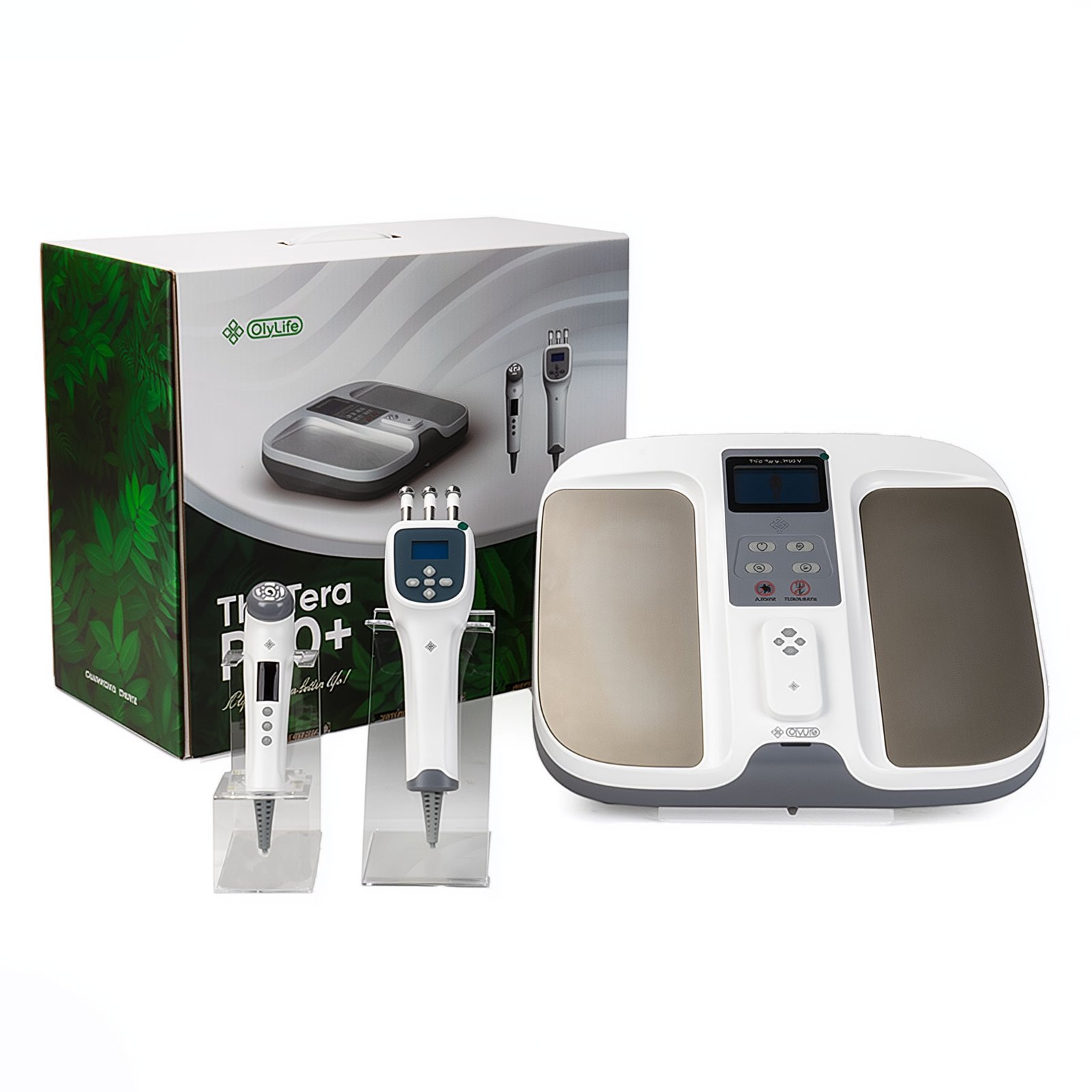
Recovery isn’t only about the cold. The OlyLife THz Tera-P90+ combines PEMF and terahertz technology in an at-home wellness set, with a Revitaluxe Massager included, that many people enjoy for calm, unhurried relaxation sessions on their rest days. It’s intended to support relaxation and general wellbeing. It’s a self-care companion, not a medical treatment, so please keep your doctor in the loop.
When the Water Is Too Cold: Cold Plunge Temperature Safety Signs
Cold water deserves respect, and the right cold plunge temperature is only half of staying safe. Cold shock, not hypothermia, causes most of the serious trouble in the first minutes, and very cold water makes it last longer. Here’s how to tell a normal reaction from a warning sign.
| Normal (expected) | Get out now |
|---|---|
| A sharp gasp and fast breathing in the first 30–60 seconds that settles within a minute or two | Breathing that won’t settle after about 2 minutes, or you can’t control it at all |
| Tingling, stinging or burning skin that fades to numbness or calm | Chest pain, a pounding or irregular heartbeat, or feeling faint |
| Bright pink or red skin | White, gray or waxy patches on your fingers or toes |
| Feeling wide awake and alert | Dizziness, confusion, slurred speech or sudden clumsiness |
| Shivering after you get out | Strong shivering while still in the water, or shivering that stops while you still feel very cold and confused (call emergency services) |
Common-sense rules
- Never plunge alone, especially in very cold or open water.
- Keep your face out of the water and don’t hold your breath under it. Researchers Shattock and Tipton describe an “autonomic conflict” when cold shock and the diving reflex hit the heart at the same time, which may trigger rhythm problems in some people.
- Skip the big hyperventilation routine right before getting in. In Tipton’s 1991 study, deep breathing beforehand didn’t reduce the gasp response. Slow, long exhales once you’re in the water are a better tool. Our Bài tập thở giúp giảm căng thẳng guide has easy techniques.
- No alcohol before or after, and don’t plunge when you’re exhausted, unwell or overheated from hard exercise.
- Get in slowly, feet first, and keep your hands out for your first few sessions if they ache.
Check with your doctor first if you have:
- Heart disease, a heart rhythm problem, high blood pressure or a history of stroke
- Raynaud’s phenomenon, cold urticaria (hives from cold) or poor circulation
- Diabetes with reduced feeling in your feet or hands
- A seizure disorder, or you’re pregnant
- Medicines that affect your heart rate or blood pressure
Cold water may be a wonderful addition to your routine, but it’s a complement to your usual care, not a replacement for it. If anything about your health makes you unsure, a quick conversation with your healthcare provider is the best first step.
Cold Plunge Temperature: Frequently Asked Questions
What is the best cold plunge temperature?
For most people, 50–59°F (10–15°C). It’s the range most research uses, and colder water hasn’t been shown to add much. Beginners can start at 60–65°F and work down.
Is 60°F cold enough for a cold plunge?
Yes, especially when you’re starting out. It’s just above the 59°F (15°C) cut-off most studies use, it still triggers a clear cold response, and it’s an excellent place to train your breathing.
Is 65°F cold enough?
It’s cool enough to feel bracing and refreshing, and it’s a gentle option if you’re very sensitive to cold. Most research uses colder water, though, so if you’re aiming for the effects described in studies, gradually work toward the 50s.
Is 34°F too cold for a cold plunge?
For home use, yes. Near-freezing water makes the cold shock last longer, cools hands and feet very quickly, and raises the risk of cold injury. There’s no good evidence that it offers more benefit than water in the 50s.
Does a colder plunge give better results?
Not according to current evidence. The 2023 review of 44 trials found that water temperature didn’t change the effect on muscle soreness, and Tipton’s work shows the initial shock at 41°F is no bigger than at 50°F, just longer. Consistency beats intensity.
Tôi nên ngâm mình trong nước lạnh bao lâu một lần?
Two to four times a week is a common, comfortable rhythm. The winter swimmers in Søberg’s study dipped 2–3 times a week. Daily is fine for some people, as long as you’re sleeping well and looking forward to it.
Tôi có nên ngâm mình trong nước lạnh sau khi tập tạ không?
If building strength or muscle is your main goal, consider leaving a gap of a few hours, or plunge on rest days. In a 12-week study by Roberts and colleagues, 10 minutes in 10°C (50°F) water after each strength session led to smaller gains in strength and muscle size than active recovery did. Our cold plunge benefits guide explains how to time it around training.
Is it better to plunge in the morning or at night?
Many people love a morning plunge for the alert, energized feeling. If you plunge in the evening, leave a gap of an hour or two before bed so you have time to warm up and wind down. Our guide to các biện pháp tự nhiên giúp ngủ ngon has more evening ideas.
Lời kết
The right cold plunge temperature isn’t the coldest one you can stand. It’s the one you can return to calmly, week after week. For most people that’s somewhere between 50 and 59°F (10–15°C), for a few minutes at a time, reached gradually from a gentler start. Measure the water instead of guessing, change one thing at a time, rewarm slowly, and never plunge alone.
Above all, listen to your body. The goal is to step out feeling awake, steady and a little proud of yourself, not rattled. Be patient with the process, because the cold gets easier much faster than most people expect. 🌿
This article is for general educational purposes and isn’t medical advice. Please talk with your healthcare provider before starting cold water immersion, especially if you have a heart condition, high blood pressure, Raynaud’s phenomenon, diabetes or are pregnant.
Tài liệu tham khảo
- Machado AF, Ferreira PH, Micheletti JK, et al. Can water temperature and immersion time influence the effect of cold water immersion on muscle soreness? A systematic review and meta-analysis. Y học thể thao. 2016;46(4):503-514. PMID: 26581833.
- Batista NP, de Carvalho FA, Machado AF, Micheletti JK, Pastre CM. What parameters influence the effect of cold-water immersion on muscle soreness? An updated systematic review and meta-analysis. Clin J Sport Med. 2023;33(1):13-25. PMID: 36399666.
- Šrámek P, Šimečková M, Janský L, Šavlíková J, Vybíral S. Human physiological responses to immersion into water of different temperatures. Eur J Appl Physiol. 2000;81(5):436-442. PMID: 10751106.
- Tipton MJ, Stubbs DA, Elliott DH. Human initial responses to immersion in cold water at three temperatures and after hyperventilation. Tạp chí Sinh lý học Ứng dụng. 1991;70(1):317-322. PMID: 2010387.
- Tipton MJ, Golden FS, Higenbottam C, Mekjavic IB, Eglin CM. Temperature dependence of habituation of the initial responses to cold-water immersion. Eur J Appl Physiol Occup Physiol. 1998;78(3):253-257. PMID: 9721005.
- Tipton MJ, Mekjavic IB, Eglin CM. Permanence of the habituation of the initial responses to cold-water immersion in humans. Eur J Appl Physiol. 2000;83(1):17-21. PMID: 11072768.
- Eglin CM, Tipton MJ. Repeated cold showers as a method of habituating humans to the initial responses to cold water immersion. Eur J Appl Physiol. 2005;93(5-6):624-629. PMID: 15778892.
- Barwood MJ, Corbett J, Wagstaff CR. Habituation of the cold shock response may include a significant perceptual component. Aviat Space Environ Med. 2014;85(2):167-171. PMID: 24597161.
- Cain T, Brinsley J, Bennett H, Nelson M, Maher C, Singh B. Effects of cold-water immersion on health and wellbeing: a systematic review and meta-analysis. PLoS One. 2025;20(1):e0317615. PMID: 39879231.
- Buijze GA, Sierevelt IN, van der Heijden BC, Dijkgraaf MG, Frings-Dresen MH. The effect of cold showering on health and work: a randomized controlled trial. PLoS One. 2016;11(9):e0161749. PMID: 27631616.
- Søberg S, Löfgren J, Philipsen FE, et al. Altered brown fat thermoregulation and enhanced cold-induced thermogenesis in young, healthy, winter-swimming men. Cell Rep Med. 2021;2(10):100408. PMID: 34755128.
- Tipton MJ, Collier N, Massey H, Corbett J, Harper M. Cold water immersion: kill or cure? Exp Physiol. 2017;102(11):1335-1355. PMID: 28833689.
- Shattock MJ, Tipton MJ. ‘Autonomic conflict’: a different way to die during cold water immersion? J Physiol. 2012;590(14):3219-3230. PMID: 22547634.
- Giesbrecht GG, Bristow GK. A second postcooling afterdrop: more evidence for a convective mechanism. Tạp chí Sinh lý học Ứng dụng. 1992;73(4):1253-1258. PMID: 1447067.
- Roberts LA, Raastad T, Markworth JF, et al. Post-exercise cold water immersion attenuates acute anabolic signalling and long-term adaptations in muscle to strength training. J Physiol. 2015;593(18):4285-4301. PMID: 26174323.