FAQ Friday: Bone Broth — 5 Honest Answers About the Cozy Winter Sip
When the air turns cold, few things feel as comforting as a warm mug of broth. Bone broth has become a wellness favorite, with claims about everything from glowing skin to “healing” your gut. So what does the research actually say? This FAQ Friday, we’re answering five common questions honestly, so you can enjoy your mug for what it really is. 🌿
1. What is bone broth, and how is it different from stock?
Bone broth is made by simmering animal bones (often with some meat, joints, and connective tissue) in water for a long time, usually 8 to 24 hours. Many cooks add a splash of vinegar, plus vegetables and herbs. It’s very close to a traditional stock. The main difference is usually just a longer simmer and a sippable seasoning. People have made versions of it for centuries in kitchens all over the world, from French bouillon to Vietnamese pho broth to Balinese soups.
2. Is bone broth a good source of collagen?
This is the most popular claim, and the evidence is weaker than the marketing suggests. In a 2019 study in the International Journal of Sport Nutrition and Exercise Metabolism (Alcock et al.), researchers measured the collagen building blocks (amino acids like glycine and proline) in homemade, café, and store-bought bone broths. Broths made to a standard recipe contained significantly lower amounts than a 20-gram dose of a collagen supplement used in research. Levels also varied a lot from batch to batch. The researchers concluded that bone broth is unlikely to be a reliable source of collagen precursors.
That doesn’t make it worthless. Broth still provides some protein and fluid. Just don’t count on it to deliver a consistent collagen “dose.”
3. Is it rich in calcium and other minerals?
It sounds logical: bones are full of calcium, so broth should be too. But a 2017 study in Food & Nutrition Research (Hsu et al.) found that homemade and commercial broths contained less than 5% of the daily recommended amount of calcium and magnesium per serving. Longer cooking and a more acidic broth did pull out more minerals, but not enough to make broth a meaningful source. For calcium, foods like yogurt, sardines, tofu, and leafy greens do much more of the work.
🎁 Get a Free Wellness Gift
Enter your name and email below to receive a special wellness gift from OlyLife — absolutely free!
4. Does a warm bowl help when you’re under the weather?
There’s a reason grandmothers swear by soup. In a small 1978 study published in Chest (Saketkhoo et al.), sipping hot chicken soup helped move nasal mucus along a little faster than hot water did, while cold water did not. A 2000 lab study, also in Chest (Rennard et al.), found that chicken soup affected the activity of certain immune cells in a test tube. That’s an interesting finding, but it hasn’t been shown in people.
The honest takeaway: warm broth won’t cure a cold, but it may be a soothing, hydrating way to get fluids and a little nourishment when your appetite is low. That’s often reason enough. For more cold-season eating ideas, see our guide to foods that support your immune system.
5. Are there any safety concerns?
A few, and they’re easy to manage:
- Lead. Bones can store small amounts of lead. A small 2013 study in Medical Hypotheses (Monro et al.) found that organic chicken-bone broths contained several times more lead than the tap water used to make them. The 2017 Hsu study, on the other hand, measured only a few micrograms of lead per serving and judged the risk minimal. A sensible middle ground is to enjoy broth as part of a varied diet rather than drinking large amounts every day. This matters especially for children and during pregnancy.
- Sodium. Store-bought broths can be salty. Look for “low sodium” labels, or salt homemade broth to taste.
- Food safety. Cool broth quickly, refrigerate it within 2 hours, and use it within 3–4 days, or freeze it in portions.
A Simple Way to Enjoy It
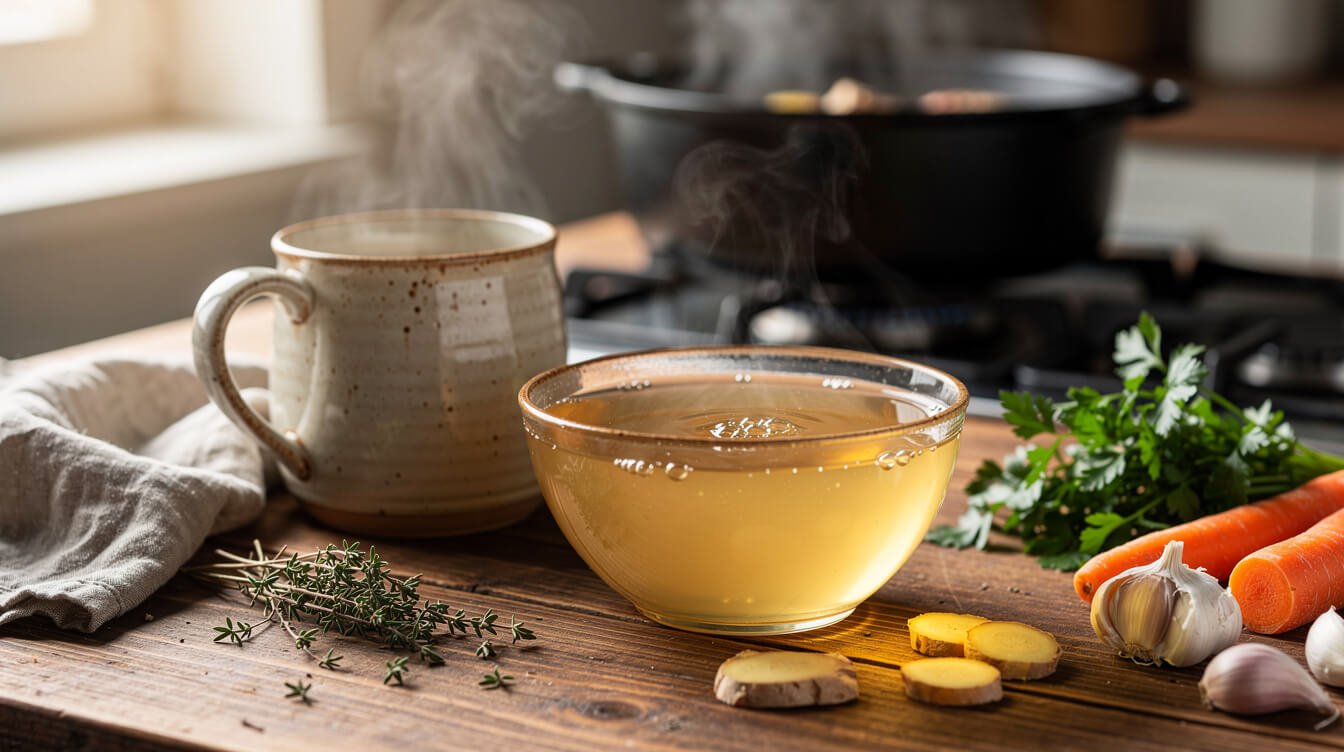
Simmer a mix of chicken or beef bones with an onion, a carrot, a few garlic cloves, and a splash of apple cider vinegar for 8 hours or more. Strain it, then sip it from a mug with a pinch of salt and a squeeze of lemon. For a bright, tropical twist, try a knotted lemongrass stalk and a few slices of ginger. It makes a lovely addition to your cold-season comfort kit. ✨
The Takeaway
Bone broth isn’t a superfood or a collagen supplement in a cup. It is a warm, hydrating, and genuinely comforting food that can be part of a nourishing winter routine. Enjoy it for the warmth and the ritual, and let your whole plate do the heavy lifting.
This post is for general educational purposes only and is not medical advice. If you’re managing high blood pressure, kidney disease, or another health condition, or if you’re pregnant, please talk with your healthcare provider about what fits your diet.