FAQ Friday: Vitamin D in Winter — 5 Common Questions, Gently Answered
The days are short, the coats are on, and most of us spend the weekend after Thanksgiving indoors. That makes late November a good time to ask a question that comes up every winter: what about vitamin D? Here are five common questions, answered gently and with the evidence in plain view. 🌿
1. Can I still make vitamin D from winter sunlight?
It depends on where you live. Your skin makes vitamin D when UVB light hits it, and in winter the sun sits too low for much UVB to get through. In a classic 1988 study, skin samples exposed to sunlight in Boston (about 42°N) made no previtamin D3 from November through February. In Edmonton (52°N) that “vitamin D winter” ran from October through March. Further south, at 34°N and 18°N, winter sunlight still worked.
The UK’s NHS gives similar advice: between October and early March, most people in the UK don’t make enough vitamin D from sunlight. So if you live as far north as Boston or beyond (think Chicago, Toronto, Seattle, or most of the UK and northern Europe), a sunny winter walk is still great for your mood and your sleep rhythm, but it may not do much for your vitamin D.
2. How much vitamin D do adults need?
In the US, the recommended amount is 600 IU (15 mcg) a day for adults 19 to 70 and 800 IU (20 mcg) a day for adults over 70, according to MedlinePlus. The UK sets a lower figure of 10 mcg (400 IU) a day for adults. Either way, these are everyday amounts, not megadoses.
3. Which foods have vitamin D?
Not many foods have much of it naturally, which is why winter can be tricky. Good options include:
- Fatty fish such as salmon, trout, sardines and mackerel. These are among the best food sources.
- Fortified foods. Most US milk is fortified (about 400 IU per quart), and so are some cereals and plant milks. Check the label.
- Egg yolks, which provide smaller amounts.
- UV-exposed mushrooms. Some store-bought mushrooms are grown under UV light and carry more vitamin D. The label usually says so.
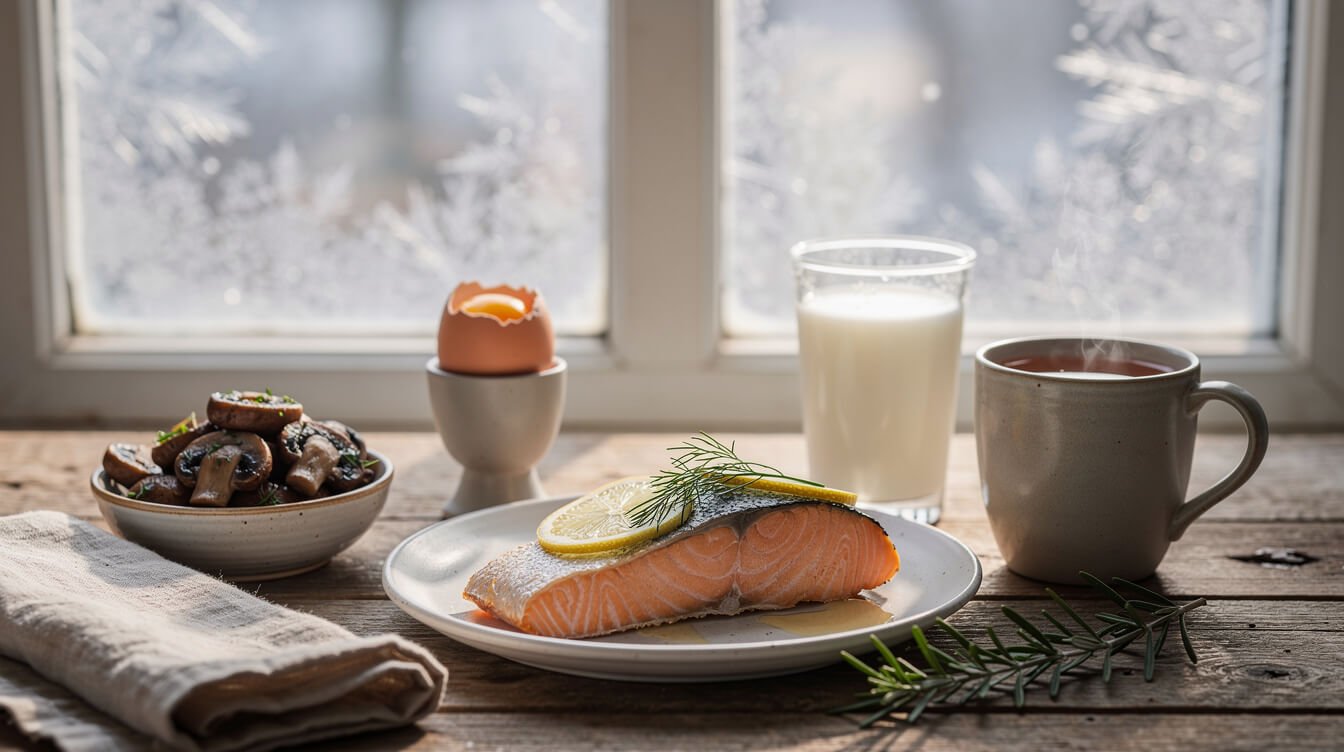
A cozy winter plate of baked salmon, a fortified breakfast and some sautéed mushrooms covers a lot of ground. Our guide to foods that support the immune system has more seasonal ideas.
4. Does vitamin D help with winter colds?
Research suggests it may offer modest support, mostly for people who are low. A 2017 BMJ meta-analysis pooled data from 25 randomized trials (about 11,000 people). Vitamin D supplements were linked with slightly fewer acute respiratory infections overall (odds ratio 0.88). The biggest benefit was in people who were very deficient and in those taking regular daily or weekly doses rather than large occasional ones.
It’s worth keeping expectations realistic, though. The large VITAL trial (2019, NEJM) gave about 25,900 older US adults 2,000 IU a day or a placebo for a median of 5.3 years. Vitamin D did not lower the rate of cancer or major heart events. Vitamin D matters, but it isn’t a cure-all, and more isn’t automatically better.
🎁 Get a Free Wellness Gift
Enter your name and email below to receive a special wellness gift from OlyLife — absolutely free!
5. Should I take a supplement, and can I take too much?
That’s a conversation to have with your health care provider, ideally with a simple blood test if they think it’s useful. The NHS suggests that people who are rarely outdoors, who usually cover most of their skin, or who have darker skin may not make enough vitamin D from sunlight and may want to consider a daily supplement all year.
More is not better. The upper limit for adults is 4,000 IU (100 mcg) a day unless a clinician recommends otherwise. Too much vitamin D can raise blood calcium, which may cause nausea, confusion and kidney problems. Please check with your doctor or pharmacist first if you take medications (some interact with vitamin D), have kidney disease, or are pregnant.
Your Weekend Step
This weekend, take a five-minute “vitamin D check-in.” Look at the labels in your fridge for fortified foods, add one fatty-fish or UV-mushroom meal to next week’s plan, and if you take a supplement, check the dose against the numbers above. Then step outside for a midday walk anyway. Your mood will thank you, even if your skin is taking the winter off. ✨
If short days are weighing on you, our gentle guide to lifting your mood when the days get short and our explainer on choosing a light therapy lamp are good next reads. And if the clock change threw off your sleep, revisit our FAQ Friday on daylight saving time.
This post is for general education and isn’t medical advice. Talk with your health care provider before starting a supplement, especially if you take medications, are pregnant or breastfeeding, or have a health condition.
Sources
- Webb AR, Kline L, Holick MF. Influence of season and latitude on the cutaneous synthesis of vitamin D3. J Clin Endocrinol Metab. 1988;67(2):373–378. doi:10.1210/jcem-67-2-373
- Martineau AR, et al. Vitamin D supplementation to prevent acute respiratory tract infections: systematic review and meta-analysis of individual participant data. BMJ. 2017;356:i6583. doi:10.1136/bmj.i6583
- Manson JE, et al. Vitamin D supplements and prevention of cancer and cardiovascular disease. N Engl J Med. 2019;380(1):33–44. doi:10.1056/NEJMoa1809944
- MedlinePlus. Vitamin D. medlineplus.gov
- NHS. Vitamin D. nhs.uk