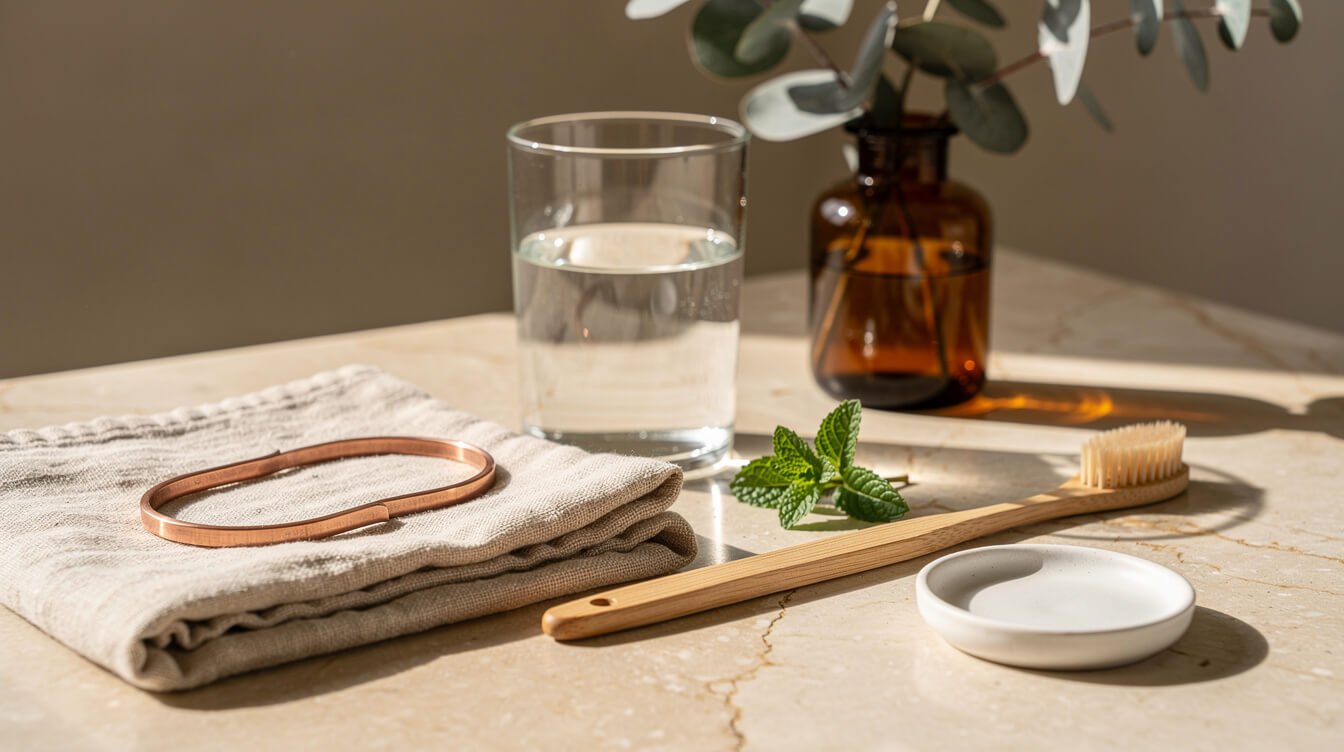
Saturday Spotlight: Tongue Scraping — The 30-Second Morning Ritual for Fresher Breath
This week’s Saturday Spotlight is a 30-second ritual that fits easily into your morning. Tongue scraping means gently drawing a small, smooth tool from the back of your tongue toward the tip to clear away the soft film that builds up overnight. In Ayurveda it’s part of the traditional morning routine, known as jihwa nirlekhana, and it’s the natural partner to last week’s oil pulling spotlight. Here’s what it is, what research suggests, and how to try it gently. 🌿
Why Your Tongue Deserves a Little Attention
The top of your tongue isn’t smooth. It’s covered in tiny bumps and grooves where food particles, dead cells and bacteria can collect into a pale coating. That coating is one of the main sources of morning breath, because the bacteria in it release smelly sulfur compounds. Brushing your teeth doesn’t always reach it. That’s where a tongue scraper comes in.
What Research Suggests
The studies are small, but they point in a consistent direction:
- Fresher breath and less coating: A 2010 systematic review looked at 5 studies (7 experiments) comparing toothbrushing alone with toothbrushing plus tongue cleaning. All of them showed a benefit for breath odor, and the authors concluded that tongue scraping or brushing has the potential to reduce bad breath and tongue coating. They also noted there wasn’t enough data on chronic, long-term bad breath (Van der Sleen et al., Int J Dent Hyg, 2010).
- The effect is short-lived: In a small crossover study with 30 adults, a single tongue cleaning with a scraper cut sulfur compounds by about 40%, compared with 33% for a toothbrush. But the effect faded within about 30 minutes (Seemann et al., J Am Dent Assoc, 2001). So think of tongue scraping as a daily habit, not a quick fix before a meeting.
- A brighter sense of taste: A 2025 systematic review of 4 studies found that cleaning a coated tongue was linked to better taste sensitivity in every study, although the improved tastes varied from study to study (Costantinides et al., Dent Med Probl, 2025). That’s a nice thought as the holiday cooking season begins. Your cardamom-spiced treats may taste even better.
Tongue scraping won’t “detox” your body, and it doesn’t replace brushing, flossing or dental checkups. It’s a simple add-on to the oral care you already do.
A Gentle 30-Second Routine
- Choose your tool. A U-shaped stainless steel or copper scraper is easy to clean. A soft toothbrush also works if you don’t have one.
- Stick out your tongue and relax. Breathe through your nose. This helps calm the gag reflex.
- Start as far back as is comfortable. You don’t need to reach the very back. Pull the scraper forward to the tip with light pressure.
- Rinse and repeat 3–5 times. Rinse the scraper under warm water between passes.
- Finish your routine. Rinse your mouth, brush and floss as usual, then wash your scraper and let it air-dry.
Many people like to scrape first thing in the morning, before a glass of water. It’s a quiet way to pair it with other slow-morning rituals, like dry brushing before your shower. ✨
🎁 Get a Free Wellness Gift
Enter your name and email below to receive a special wellness gift from OlyLife — absolutely free!
Be Gentle: When to Check In With Your Dentist
A scraper should feel like a light sweep, never like scrubbing. Press too hard and you can irritate the tongue. Stop if you notice soreness, bleeding or small cuts, and replace any scraper with rough or damaged edges. Skip it if you have tongue piercings, mouth sores or a recent mouth injury. Bad breath that doesn’t go away, a white or discolored coating that keeps coming back, or a tongue that is painful, swollen or patchy deserves a visit to your dentist or doctor rather than more scraping. Persistent bad breath can have other causes, such as gum disease, dry mouth, sinus issues or reflux.
The Takeaway
Tongue scraping is one of the easiest wellness habits you can add. It’s cheap, takes 30 seconds, and early research suggests it may help freshen your breath and reduce tongue coating, and may even help you taste your food more fully. Try it every morning this week and notice how your mouth feels. 🌿
This post is for general wellness education and isn’t medical or dental advice. If you have concerns about your mouth, breath or tongue, please talk with your dentist or a qualified healthcare provider.
References
Van der Sleen MI, Slot DE, Van Trijffel E, Winkel EG, Van der Weijden GA. Effectiveness of mechanical tongue cleaning on breath odour and tongue coating: a systematic review. Int J Dent Hyg. 2010;8(4):258–268.
Seemann R, Kison A, Bizhang M, Zimmer S. Effectiveness of mechanical tongue cleaning on oral levels of volatile sulfur compounds. J Am Dent Assoc. 2001;132(9):1263–1267.
Costantinides F, et al. Efficacy of mechanical tongue cleaning on taste perception: a systematic review. Dent Med Probl. 2025;62(2):361–369.