Monday Myth-Busting: 3 Thanksgiving “Food Coma” Myths to Rethink Before Thursday
Every year around this time, someone at the table pats their belly, sinks into the couch, and blames the turkey. 🦃 It’s a fun bit of holiday lore, but the science tells a more interesting story. Knowing what actually drives that heavy, post-feast drowsiness can help you enjoy Thursday’s meal and still have energy for the evening.
Here are three “food coma” myths worth rethinking before Thanksgiving.
Myth #1: “The tryptophan in turkey is what knocks you out”
Turkey does contain tryptophan, an amino acid your body uses to make serotonin and, later, melatonin. But turkey isn’t unusually rich in it. It’s in roughly the same range as chicken and other common proteins, and nobody blames a chicken sandwich for an afternoon nap.
There’s also a twist. In classic research from the early 1970s, Fernstrom and Wurtman found that protein-rich meals raised tryptophan in the blood but didn’t raise it in the brain. Tryptophan has to compete with several other amino acids to get into the brain, and a protein-heavy meal brings plenty of competitors along. What mattered most was the ratio of tryptophan to those other amino acids, not the amount on your plate.
The takeaway: the turkey is a convenient scapegoat. The whole feast and the whole day are much more likely to be behind the slump.
Myth #2: “It’s all about what’s on your plate (carbs, fat, or protein)”
It feels logical that one food group must be the culprit. The research is more nuanced. In a small sleep-lab study, Orr and colleagues (1997) gave healthy men a solid meal, a liquid meal, or an equal volume of water, then measured how quickly they fell asleep at nap times. The solid meal helped people drift off faster than water did. When the researchers compared high-fat, high-carb, and mixed meals, though, the type of meal made no significant difference.
Other studies suggest the mix can still play a small role. In one, people reported feeling a bit more tired a few hours after a high-fat breakfast than after a high-carb one (Wells et al., 1997). So the honest answer is that simply eating a big, satisfying meal seems to be one of the main drivers. A few other Thanksgiving regulars add to it:
- Timing: many families eat mid-afternoon, which lines up with the body’s natural afternoon dip in alertness.
- A short night: early cooking, travel, and late conversations add up to a sleep debt.
- Drinks: alcohol tends to make you fall asleep faster, but research reviews find it also disrupts sleep in the second half of the night (Ebrahim et al., 2013). That’s one reason Friday can feel foggy.
The takeaway: focus on portion size and pacing rather than banning any one food. Enjoy the stuffing!
Myth #3: “The best fix is to lie down right after the meal”
Stretching out on the couch the moment the plates are cleared is tempting. But lying flat on a very full stomach may encourage heartburn for some people. In a Japanese case-control study, adults who went to bed less than three hours after dinner had much higher odds of reflux disease than those who waited four hours or more (Fujiwara et al., 2005). That’s an association, not proof of cause, but the practical advice is the same: give your meal some upright time.
A gentle stroll is a lovely alternative. Light walking after eating may help smooth out post-meal blood sugar. We covered that research in our 15-minute Thanksgiving week wellness plan. If you still want a rest afterward, a short nap in a comfy chair (around 20 minutes) is a cozy compromise.
🎁 Get a Free Wellness Gift
Enter your name and email below to receive a special wellness gift from OlyLife — absolutely free!
Your Thursday “Food Coma” Game Plan 🌿
- Don’t skip breakfast to “save room.” Arriving starving usually means eating faster and more. A light, protein-rich breakfast keeps you steadier.
- Serve yourself one plate, then pause. Wait 10–15 minutes before going back for seconds. Fullness signals need a little time.
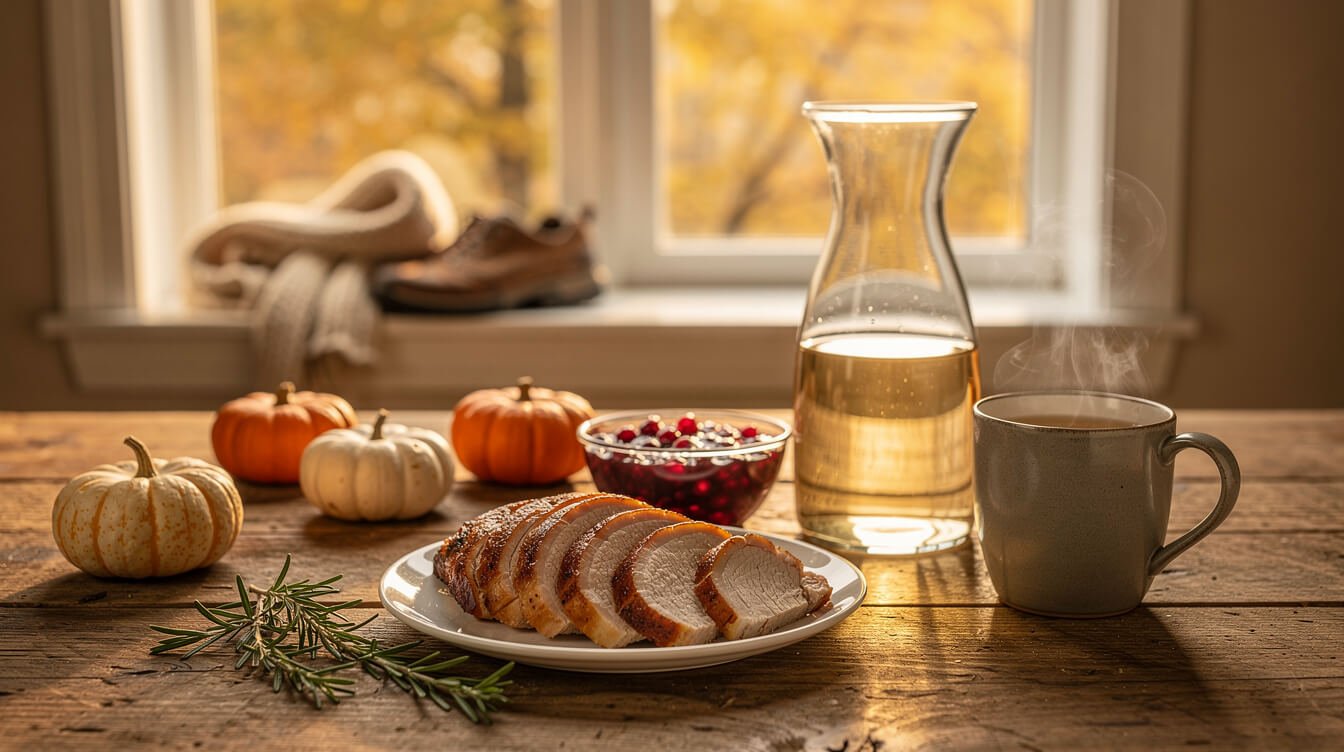
- Alternate drinks with water. Keep a water pitcher on the table and enjoy a glass between festive drinks.
- Take a 10-minute walk after the meal. Invite the family. It’s a lovely new tradition.
- Stay upright for a while. Aim for about three hours between your last big bite and bedtime. A warm cup of ginger or peppermint tea can be a soothing way to close the evening. Here’s our guide to herbal teas for digestion.
- Protect Wednesday night’s sleep. A rested body handles a big meal with more grace. Our holiday stress and sleep FAQ has gentle ideas.
And if you nod off during the football game anyway? That’s okay. Thanksgiving is about connection and gratitude, not perfection. ✨ For more myth-busting before the holidays, read our 3 metabolism myths to rethink.
This post is for general education and isn’t medical advice. If you have frequent heartburn, diabetes, a digestive condition, or a sleep disorder, or if you feel unusually sleepy after meals on a regular basis, please talk with your healthcare provider.
Sources
- Fernstrom JD, Wurtman RJ. Brain serotonin content: physiological regulation by plasma neutral amino acids. Science. 1972;178(4059):414–416. doi:10.1126/science.178.4059.414
- Orr WC, Shadid G, Harnish MJ, Elsenbruch S. Meal composition and its effect on postprandial sleepiness. Physiol Behav. 1997;62(4):709–712. doi:10.1016/s0031-9384(97)00012-7
- Wells AS, Read NW, Uvnas-Moberg K, Alster P. Influences of fat and carbohydrate on postprandial sleepiness, mood, and hormones. Physiol Behav. 1997;61(5):679–686. doi:10.1016/s0031-9384(96)00519-7
- Ebrahim IO, Shapiro CM, Williams AJ, Fenwick PB. Alcohol and sleep I: effects on normal sleep. Alcohol Clin Exp Res. 2013;37(4):539–549. doi:10.1111/acer.12006
- Fujiwara Y, Machida A, Watanabe Y, et al. Association between dinner-to-bed time and gastro-esophageal reflux disease. Am J Gastroenterol. 2005;100(12):2633–2636. doi:10.1111/j.1572-0241.2005.00354.x