Acupressure Points for Headache Relief: 8 Traditional Points, What Research Suggests, and a 5-Minute Routine
A headache has a way of shrinking your world. The screen gets too bright, every sound has an edge, and the to-do list you were excited about this morning suddenly feels impossible. If you’ve been searching for acupressure points for headache relief, you’re probably looking for something calm and practical you can do with your own hands, right now, wherever you are. That’s exactly what acupressure offers. A small but real body of research suggests that pressing certain points, especially around the neck, shoulders, and head, may help ease everyday tension-type headaches and support relaxation while you wait for one to pass.
Most acupressure points headache relief guides list four or five spots, suggest a 10-second squeeze, and stop there. This guide goes further. You’ll learn how to tell a tension headache from a migraine (because the approach differs), where to find eight traditional points using simple finger-width measurements, how firmly and how long to press, what the studies actually found (including where the evidence is thin), and a gentle 5-minute routine you can do at your desk or before bed. You’ll also find the warning signs that mean a headache needs a doctor, not a thumb.
And if your head has felt a little foggy since the clocks fell back this weekend, you’re not imagining it. Shifts in sleep and meal times are a common headache trigger, so this is a lovely week to build a calm, reliable reset ritual. 🌿
A gentle note: This article is for general education and isn’t medical advice. Acupressure is a complementary self-care practice, not a replacement for diagnosis or treatment. If your headaches are new, severe, getting worse, or come with any of the warning signs listed later in this guide, please talk with your healthcare provider.
Do Acupressure Points for Headache Relief Really Work? What Research Suggests

Acupressure comes from traditional Chinese medicine (TCM). It uses the same points as acupuncture, but instead of needles you use steady pressure from your fingers or thumbs. In TCM, points such as Fengchi (GB20) at the base of the skull and Hegu (LI4) on the hand have been used for centuries to support comfort in the head and neck.
From a modern point of view, there are a few plausible reasons pressing these spots may help. Many of the classic headache points sit right over muscles that commonly hold tension, such as the suboccipitals at the base of the skull, the upper trapezius across the shoulders, and the temporalis at the temples. Firm, slow pressure may soften tight, tender spots in these muscles. It also gives your nervous system a strong, pleasant signal that can compete with pain signals. And because you naturally slow your breathing while you press, acupressure may nudge your body toward its “rest and digest” mode. Our guide to vagus nerve exercises explores that calming response in more depth.
What the studies found
Here’s an honest snapshot of the research, from strongest to most preliminary. Notice that the best evidence is for acupuncture, which uses the same points but isn’t the same as pressing them yourself.
| Approach | Key study | What it found | Strength of evidence |
|---|---|---|---|
| Acupuncture for tension-type headache | Linde 2016 Cochrane review (12 trials, 2,349 people) | About half of people had their headache frequency cut by at least 50%, compared with 19% on routine care in the largest trial. The edge over sham needling was smaller (51% vs 43%). | Moderate. The strongest data on these points, but needles aren’t fingers. |
| Acupuncture for migraine prevention | Linde 2016 Cochrane review (22 trials, 4,985 people) | Headache frequency at least halved in 41% vs 17% with no acupuncture. Results were similar to preventive medicines over three months. | Moderate. Done by trained practitioners. |
| Self-acupressure for chronic headache | Hsieh 2010, randomized trial (28 people in Taiwan) | After one month, pain scores were lower with acupressure than with a muscle-relaxant medicine, and the difference held at six months. | Promising, but very small. |
| Acupressure for headache in dialysis patients | Narimani 2026, randomized trial (33 people) | One minute each on LI4, Yintang, Taiyang, and GB20 lowered headache severity compared with routine care, about as much as eucalyptus inhalation. | Preliminary. Small and in a specific group. |
| Wrist acupressure for migraine nausea | Allais 2012 (40 women); Xu 2017 (98 people) | Pressure on PC6 eased migraine-related nausea. In Xu’s trial it didn’t reduce the pain itself. | Moderate for nausea, not for pain. |
| Neck and head trigger-point massage | Moraska 2015 (56 people with tension-type headache) | Headache frequency fell with massage, but it also fell with a placebo treatment. People felt the massage helped more. | Mixed. A reminder that expectation and relaxation matter too. |
The takeaway? Acupressure is a low-cost, low-risk self-care tool that research suggests may help some people with tension-type headaches, and that may ease the nausea that often rides along with migraine. It isn’t a proven cure for either, and the studies on pressing points yourself are still small. That’s exactly why we recommend using it as one gentle part of a broader plan, alongside sleep, hydration, movement, and your healthcare provider’s advice. Our broader guide to natural pain relief for headache covers the other pieces.
Tension Headache, Migraine, or Something Else? Why It Matters for Acupressure

Headaches are incredibly common. A 2022 global review (Stovner, 357 studies) estimated that about 52% of adults have an active headache disorder, with tension-type headache affecting about 26% and migraine about 14%. On any given day, roughly one in six people in the world has a headache. Knowing which kind you tend to get helps you use acupressure wisely.
Tension-type headache
This is the “tight band” headache. It usually feels like pressing or squeezing on both sides of the head, mild to moderate, often with sore neck and shoulder muscles. It doesn’t usually get worse with routine activity like walking up stairs. This is where acupressure may be most useful, because many of the points sit right on the muscles involved. Long screen days, a stiff posture, stress, and short sleep are classic triggers.
Migraine
Migraine tends to be throbbing, often on one side, moderate to severe, and worse with movement. It commonly brings nausea and sensitivity to light and sound. Some people see visual changes (an “aura”) beforehand. Acupressure isn’t a substitute for a migraine plan from your doctor, but the PC6 wrist point may help with the nausea, and gentle work on the neck and shoulders may feel soothing in a quiet, dark room.
Sinus pressure and eye strain
A heavy, full feeling behind the cheeks and forehead during a cold can respond to the facial points covered in our sinus acupressure point guide. Tired, achy eyes after a long day of screens often improve with breaks. Try the 20-20-20 eye-break rule, and use the brow points below gently.
If your headaches don’t fit any of these patterns, have changed recently, or worry you, that’s a reason to see a professional before you rely on self-care. We’ve listed the specific warning signs near the end of this guide.
8 Acupressure Points for Headache Relief (and How to Find Them)

Acupressure uses a simple body-based ruler called a cun (pronounced “tsoon”). One cun is the width of your thumb at the knuckle. Three cun is the width of your four fingers held together at the middle knuckle. Because it’s based on your own hand, it scales to your body. When you find the right spot, it often feels slightly tender or “achy-good” compared with the area around it.
1. Fengchi (GB20), “Wind Pool”
Where: At the base of your skull, in the two hollows between the big vertical neck muscles and the bony bumps behind your ears. Slide your thumbs up the back of your neck until they drop into the soft dips just under the skull.
How: Interlace your fingers behind your head and press your thumbs upward and slightly inward, toward the center of your head. Hold steady pressure while you breathe slowly. This is often the most welcome point for desk-day tension headaches and was used in the Hsieh and Narimani trials.
2. Jianjing (GB21), “Shoulder Well”
Where: On top of each shoulder, halfway between the base of your neck (the bony bump at the bottom of your neck) and the outer tip of your shoulder. It’s usually the highest, most knotted point of the muscle.
How: Reach across with the opposite hand and squeeze the muscle between your fingers and the heel of your hand, or press down with two fingers. Use moderate pressure. Skip this point during pregnancy, as it’s traditionally avoided.
3. Taiyang, “Supreme Yang” (temples)
Where: In the soft depression at your temple, about one thumb-width behind the midpoint between the outer end of your eyebrow and the outer corner of your eye.
How: Use your middle fingers to make slow, small circles with light-to-moderate pressure. The temples are sensitive, so go softer here than on the neck.
4. Yintang, “Hall of Impression”
Where: Midway between your eyebrows, where the bridge of the nose meets the forehead.
How: Press gently with one fingertip or make tiny circles. Many people find this point naturally calming. A 2015 review of acupressure for anxiety (Au 2015) found Yintang among the points most often used in those studies, and it pairs nicely with slow breathing.
5. Zanzhu (BL2), “Gathering Bamboo”
Where: In the small notch at the inner end of each eyebrow, just above the inner corner of the eye.
How: Press upward lightly with both index fingers at once. This point is traditionally used for brow-area discomfort and tired eyes. Keep pressure gentle and away from the eye itself.
6. Baihui (GV20), “Hundred Meetings”
Where: On the top of your head. Imagine a line from the tip of one ear, over the crown, to the tip of the other ear. Baihui sits where that line crosses the center of your head.
How: Press down with a fingertip or rest your palm there and make slow circles. It’s often used for a sense of grounding. GV20 was one of the most-used points in the Hsieh 2010 trial.
7. Hegu (LI4), “Union Valley”
Where: On the back of your hand, in the fleshy web between your thumb and index finger. Squeeze your thumb against your index finger. The point is at the top of the muscle mound that forms.
How: Pinch the web firmly between the thumb and fingers of your other hand, angling pressure toward the index-finger bone. It’s handy because you can do it discreetly in a meeting. Don’t use LI4 if you’re pregnant, as it’s traditionally avoided. Our acupressure points on hand guide has more detail on finding it.
8. Taichong (LR3), “Great Rushing”
Where: On the top of your foot, in the hollow between the bones of your big toe and second toe, about two thumb-widths up from the web.
How: Press with your thumb while seated, angling slightly toward the second toe. In TCM, LR3 is often paired with LI4 (together called the “four gates”) to support relaxation.
Bonus for migraine nausea: Neiguan (PC6)
Where: On the inside of your forearm, three finger-widths up from the wrist crease, between the two tendons.
How: Press steadily with your thumb, or wear a commercial acupressure wristband. In the Allais 2012 study, a wristband on PC6 eased nausea during migraine attacks. Use light pressure if you have carpal tunnel symptoms, since the median nerve runs here.
How to Press: Pressure, Timing, and Setup

Technique matters more than the number of points. Here’s what the research protocols and traditional practice have in common.
How firm is “firm”?
Aim for pressure that feels strong but comfortable, a 5 to 7 out of 10, never sharp pain. Many acupressure studies use roughly 3 to 5 kg of force, about 7 to 11 lb (Waits 2018 review). Want to calibrate? Press your thumb onto a kitchen scale until it reads 3 to 4 kg. That’s often firmer than people expect for the neck and hands, and much firmer than you want for the temples or brows.
How long?
Hold each point for 1 to 2 minutes, or use slow circles for the same time. Studies have used anywhere from 1 minute per point (Narimani 2026) to longer, repeated sessions over a month (Hsieh 2010). If you only have 60 seconds, spend it on GB20.
Breathe with it
Breathe in through your nose for about four counts and out for about six. Slightly longer exhales may support your body’s relaxation response, and they help you stay with the pressure rather than tensing against it. Our guide to breathwork for stress relief has more techniques if you’d like to go deeper.
When to press
- At the first hint of tension: Many people find acupressure most useful early, before a headache builds.
- As a daily habit: In the studies, benefits came from regular practice over weeks, not a single session.
- Before bed: A short routine can double as a wind-down.
Setup tips
- Sit upright with your feet flat and shoulders relaxed, or lie on your back for the neck points.
- Warm your hands first, or try a warm compress on your neck for a few minutes beforehand.
- Short nails help. Use the pad of your thumb or finger, not the tip.
- Work both sides of the body for paired points.
A Gentle 5-Minute Routine for Acupressure Points Headache Relief

This sequence moves from the neck and shoulders, where tension usually starts, to the head and then the hands and feet. Do it seated at your desk, on the sofa, or in bed. Try it for two weeks and notice how you feel.
- Settle (30 seconds). Drop your shoulders, unclench your jaw, and take three slow breaths with long exhales. If you can, dim the screen or close your eyes.
- Fengchi, GB20 (1 minute). Thumbs in the hollows at the base of your skull. Press up and in, then make small circles. Let your head rest back into your hands.
- Jianjing, GB21 (1 minute). Squeeze the top of the right shoulder with your left hand for 30 seconds, then switch. Roll your shoulders back slowly once or twice afterward.
- Taiyang and Yintang (1 minute). Gentle circles at both temples for 30 seconds, then a light press between the brows for 30 seconds, followed by a soft sweep along both eyebrows with BL2 at the inner ends.
- Baihui, GV20 (30 seconds). Rest a fingertip on the crown and press gently while you breathe.
- Hegu and Taichong (1 minute). Pinch LI4 on each hand for 15 seconds. If you’re seated with access to your feet, press LR3 on each foot for 15 seconds. Skip LI4 if you’re pregnant.
- Close (a few breaths). Sip a glass of water and notice your shoulders, jaw, and brow. Is anything softer?
If nausea is part of your migraine pattern, add a minute on PC6 at the wrist. If one point feels especially good, it’s fine to spend more time there and skip others. This is your routine.
Some people like to follow a session with gentle warmth across the neck and shoulders as part of a relaxing evening ritual. The OlyLife Vitality Wand is a handheld terahertz and PEMF wellness device that many of our customers enjoy for exactly that kind of slow, calming wind-down. It’s designed to support relaxation, not to treat headaches, and it’s a nice-to-have rather than a need-to-have. Your hands are the real tool here.
🎁 Get a Free Wellness Gift
Enter your name and email below to receive a special wellness gift from OlyLife — absolutely free!
Pair Acupressure With Habits That May Support Fewer Headaches
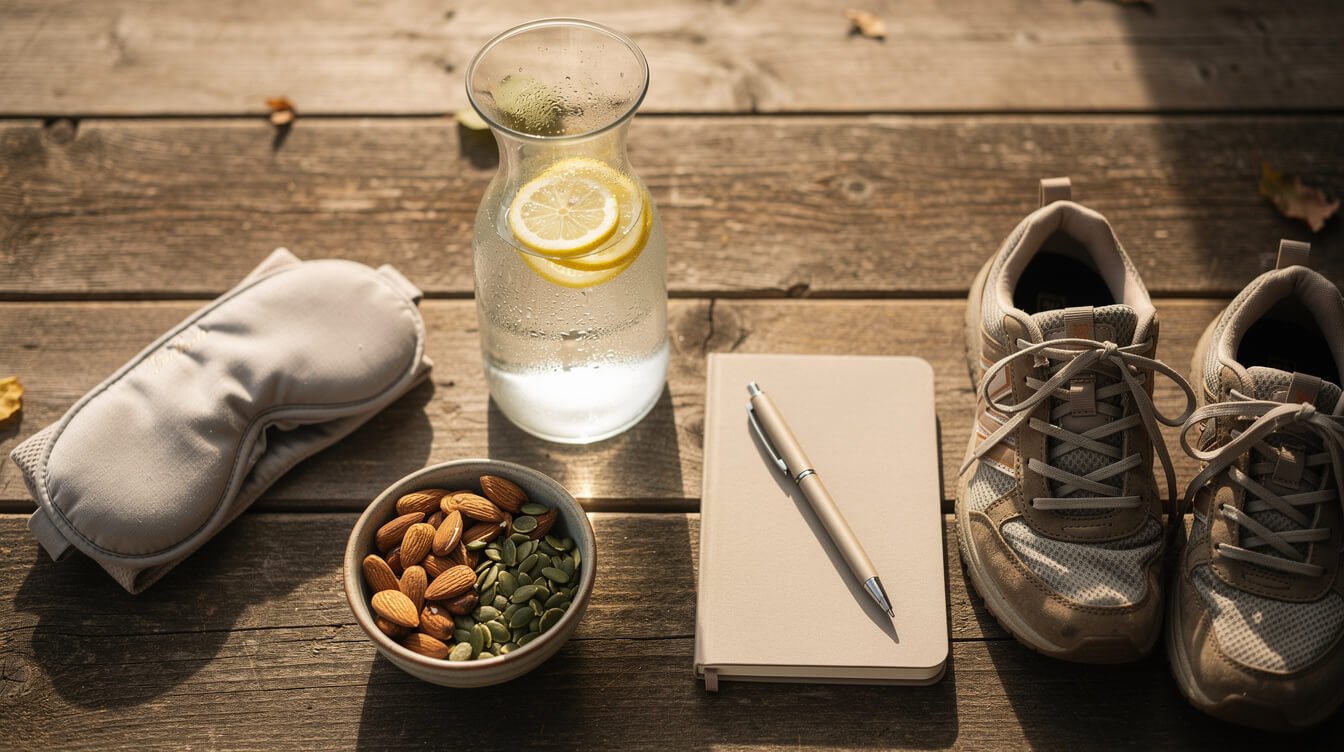
Acupressure works best as part of a bigger picture. These everyday basics may help reduce how often headaches show up in the first place.
Protect your sleep, especially this week
Both too little and irregular sleep are well-known headache triggers. After a time change, keep your wake time steady, get morning daylight, and avoid “catching up” with long lie-ins. Our guide on how to improve sleep quality naturally has a full plan, and our winter blues guide covers the shorter days ahead.
Drink water steadily
In a randomized trial of 102 people with recurrent headaches (Spigt 2012), adding about 1.5 liters of water a day didn’t reduce the number of headache days, but people reported better quality of life and more of them felt improved (47% vs 25%). It’s a small, low-risk step worth trying, especially in dry, heated indoor air.
Eat regularly and consider magnesium-rich foods
Skipped meals are a common trigger for both tension headaches and migraine. Leafy greens, nuts, seeds, and legumes are rich in magnesium, which is often discussed in migraine care. Our magnesium benefits guide explains the research. Talk to your doctor before starting a supplement, especially if you have kidney issues or take other medicines.
Watch caffeine and screen time
Keep caffeine consistent rather than swinging between lots and none, since withdrawal can trigger headaches. Take regular screen breaks, and set your monitor at eye level so your neck isn’t craning forward all day.
Move and release your neck and shoulders
Regular walking and gentle neck and shoulder stretches may ease the muscle tension behind many headaches. Our tennis ball self-massage routine is a lovely companion to the points above.
Keep a simple headache diary
For two to four weeks, jot down when headaches start, how strong they are, what you’d eaten and how you’d slept, and what helped. Patterns often jump out, and the diary is gold for your doctor if you decide to get checked.
Build a Calming Ritual for Tense Neck and Shoulders ✨
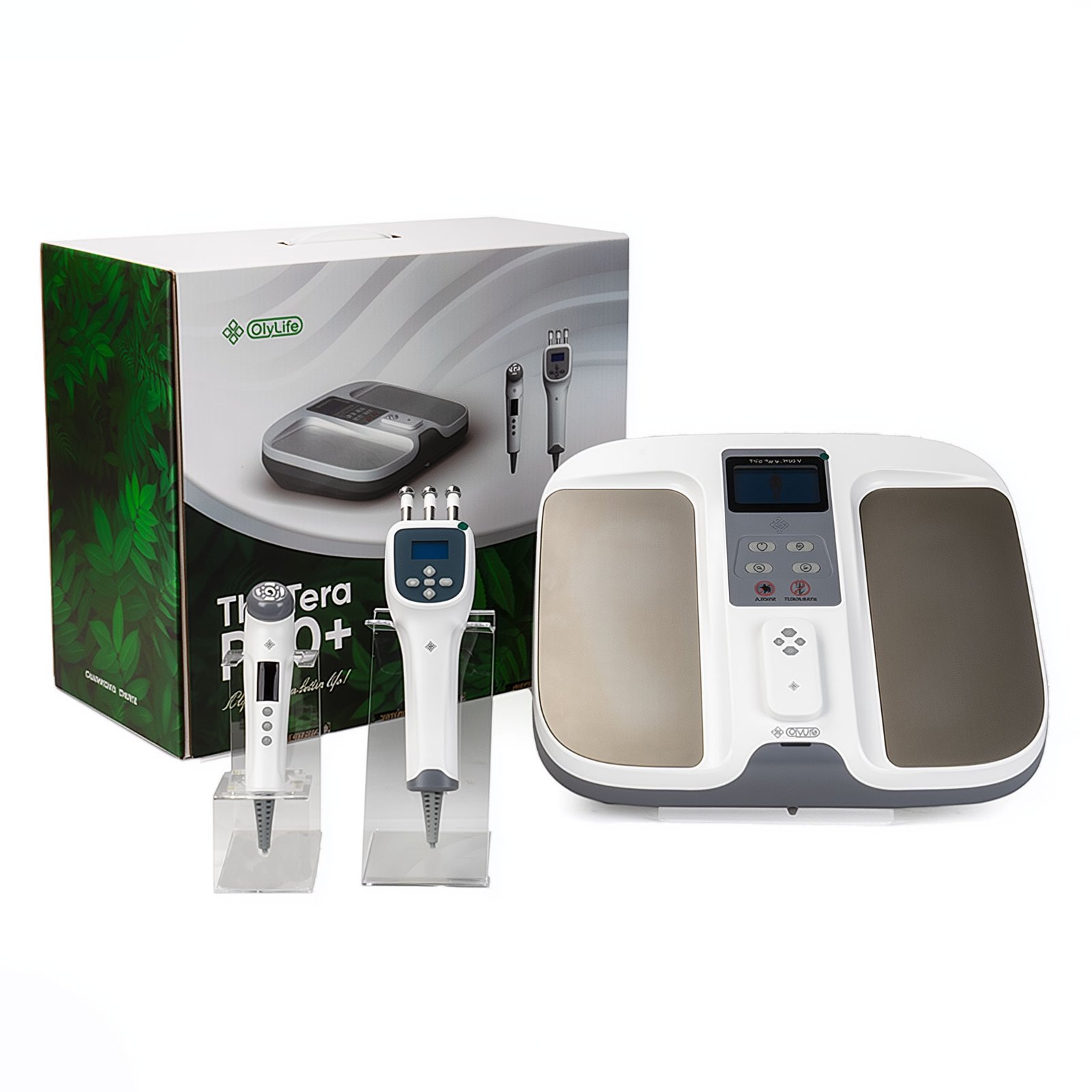
The OlyLife THz Tera-P90+ is designed to deliver focused PEMF and terahertz frequencies, and many customers use it as an adjunct to their existing wellness routine, alongside stretching, slow breathing, and acupressure. It’s designed to support relaxation and general wellbeing, not to diagnose, treat, or relieve headaches or any other condition.
Safety First: Who Should Be Careful, and When to See a Doctor

Self-acupressure is low-risk for most adults, and the studies above reported few, if any, side effects. Still, a few situations call for extra care.
| Situation | What to do |
|---|---|
| Pregnancy | Avoid LI4 and GB21, which are traditionally avoided in pregnancy. Check with your midwife or doctor before trying acupressure, and always mention new or severe headaches in pregnancy promptly. |
| Neck injury, recent whiplash, or neck surgery | Don’t press the neck points. Ask your provider first. |
| Blood thinners or bleeding disorders | Use light pressure only, since firm pressure can bruise. |
| Carpal tunnel symptoms | Use only light pressure on PC6, which sits over the median nerve. |
| Broken skin, bruises, rashes, or varicose veins at a point | Skip that point. |
| Frequent use of pain relievers | Taking headache medicines on many days each month can itself keep headaches going (medication-overuse headache). If you’re reaching for them more than a couple of days a week, talk to your doctor. |
Get urgent medical care if a headache:
- Comes on suddenly and severely, reaching its worst within about a minute (“thunderclap”)
- Comes with fever, a stiff neck, confusion, or a rash
- Comes with weakness, numbness, trouble speaking, vision loss, or a drooping face
- Follows a head injury
See your doctor soon if:
- Your headaches are new, especially if you’re over 50, or the pattern has clearly changed
- They’re getting steadily worse over days or weeks
- They’re triggered by coughing, sneezing, straining, or exercise, or change a lot when you lie down or stand up
- You’re pregnant or recently gave birth
- You have a history of cancer or a weakened immune system
- You have a painful red eye with your headache
These warning signs come from the SNNOOP10 list that neurologists use to spot headaches that may have another cause (Do 2019). They’re uncommon, but they’re the reason no self-care guide should replace a check-up when something feels different.
Frequently Asked Questions About Acupressure Points for Headache Relief

What is the best pressure point for a headache?
There’s no single “best” point for everyone. For tension headaches that start in the neck, many people find Fengchi (GB20) at the base of the skull the most helpful. Hegu (LI4) on the hand is the most portable. Try a few and notice which ones feel best for you.
How long does acupressure take to work?
Some people notice their muscles soften within a few minutes of a session. In studies, the benefits came from regular practice over about one month (Hsieh 2010), so think of it as a habit rather than an instant fix.
Can acupressure help migraines?
Research suggests acupuncture may help prevent migraine for some people when done by a trained practitioner. For self-acupressure, the clearest evidence is for easing migraine-related nausea with the PC6 wrist point. In a 2019 trial of 76 people with migraine (Vagharseyyedin), bedtime self-acupressure eased fatigue more than pressing sham points, though sleep quality didn’t differ. It’s best used alongside the migraine plan you’ve made with your doctor, not instead of it.
Is it safe to press LI4 every day?
For most adults, gentle daily pressure on LI4 is fine. The main exception is pregnancy, when LI4 is traditionally avoided. If you bruise easily or take blood thinners, use lighter pressure.
Can acupressure replace headache medicine?
No. Acupressure is a complementary self-care practice. Many people use it to feel more in control and to lean less often on quick fixes, but changes to any medication should always be made with your healthcare provider.
Should I see an acupuncturist instead?
If headaches are frequent, a licensed acupuncturist is worth considering, since acupuncture has the strongest research behind it of the approaches here. They can also show you which points to press at home between visits.
Final Thoughts: Gentle Hands, Calmer Head
Headaches are common, but that doesn’t make them any less draining. Acupressure points for headache relief, especially Fengchi at the base of the skull, Jianjing on the shoulders, and Hegu on the hand, give you a calm, hands-on way to respond when tension starts to build. The research on pressing points yourself is still young, and it’s strongest for tension-type headaches and migraine nausea. That’s exactly why the best approach is a routine: steady sleep, regular meals and water, screen breaks, movement for your neck and shoulders, and a few mindful minutes of pressure and slow breathing.
Start small this week. Pick three points, try the 5-minute routine once a day, and jot a quick note about how you feel. Be patient with yourself on harder days. And if anything on the warning-sign list shows up, let your doctor be part of the plan. ✨
Want to keep building your self-care toolkit? Explore our guide to acupressure points for constipation for a gentle morning routine, too.
References
- Linde K, et al. Acupuncture for the prevention of tension-type headache. Cochrane Database Syst Rev. 2016. PMID 27092807
- Linde K, et al. Acupuncture for the prevention of episodic migraine. Cochrane Database Syst Rev. 2016. PMID 27351677
- Hsieh LL, et al. Effect of acupressure and trigger points in treating headache: a randomized controlled trial. Am J Chin Med. 2010. PMID 20128040
- Narimani MM, et al. Comparative effectiveness of acupressure and eucalyptus aromatherapy on headache severity in hemodialysis patients: a randomized controlled clinical trial. Health Sci Rep. 2026. PMID 42124882
- Allais G, et al. Acupressure in the control of migraine-associated nausea. Neurol Sci. 2012. PMID 22644205
- Xu JH, Mi HY. A randomized controlled trial of acupressure as an adjunctive therapy to sodium valproate on the prevention of chronic migraine with aura. Medicine (Baltimore). 2017. PMID 28682918
- Vagharseyyedin SA, et al. The impact of self-administered acupressure on sleep quality and fatigue among patients with migraine: a randomized controlled trial. Complement Ther Clin Pract. 2019. PMID 30600173
- Moraska AF, et al. Myofascial trigger point-focused head and neck massage for recurrent tension-type headache: a randomized, placebo-controlled clinical trial. Clin J Pain. 2015. PMID 25329141
- Stovner LJ, et al. The global prevalence of headache: an update, with analysis of the influences of methodological factors on prevalence estimates. J Headache Pain. 2022. PMID 35410119
- Price A, Burls A. Increased water intake to reduce headache: learning from a critical appraisal (of Spigt et al. 2012). J Eval Clin Pract. 2015. PMID 26200171
- Do TP, et al. Red and orange flags for secondary headaches in clinical practice: SNNOOP10 list. Neurology. 2019. PMID 30587518
- Au DW, et al. Effects of acupressure on anxiety: a systematic review and meta-analysis. Acupunct Med. 2015. PMID 26002571
- Waits A, et al. Acupressure effect on sleep quality: a systematic review and meta-analysis. Sleep Med Rev. 2018. PMID 28089414