助眠穴位按摩:8個傳統穴位、研究結果以及5分鐘睡前按摩程序
It’s late, the house is quiet, and your mind is still running at full speed. You’ve tried counting backward, flipping the pillow to the cool side and promising yourself you’ll stop checking the clock. If that sounds familiar, acupressure points for sleep are one of the gentlest things you can add to your evening: a few minutes of slow, steady pressure on spots that traditional Chinese medicine has long associated with a calmer mind and an easier drift into sleep. You don’t need any equipment, and you can do it lying in bed with the lights already off.
This guide covers eight traditional points, how to find each one, and a simple 5-minute bedtime routine. It also covers something most pressure-point lists leave out: what the research actually suggests, how strong that evidence is, and where acupressure fits next to the sleep habits that have the best track record. We’ll also be clear about when sleepless nights deserve a conversation with your doctor.
開始之前,先簡單說明一點: This article is for general education and isn’t medical advice. Acupressure may support relaxation and better sleep, but it isn’t a substitute for care from a qualified professional. If you’re pregnant, take sleep medication, or have a health condition, check with your doctor first.
Why Acupressure Points for Sleep Are Worth a Try
Poor sleep is common. Roughly 1 in 3 US adults regularly sleeps less than the recommended seven hours (Liu 2016). About 10% of adults meet the criteria for an insomnia disorder, and another 20% or so have occasional insomnia symptoms. Women, older adults and people under financial strain are the most affected (Morin & Jarrin 2022).
For most people, the problem at bedtime isn’t the body. It’s the mind. Worries, to-do lists and the day’s replay keep the nervous system alert just when it should be shifting down. That’s where acupressure can help. It gives your hands a slow, repetitive job and your attention a single place to rest. It also pairs naturally with slow breathing, which many people find calming in its own right.
What acupressure is (and isn’t)
Acupressure comes from the same tradition as acupuncture, but it uses fingertip or thumb pressure instead of needles. In traditional Chinese medicine, specific points (called 穴位) sit along pathways called meridians, and pressing them is traditionally used to calm the “shen,” often translated as the spirit or mind. Modern researchers describe it differently. They look at things like touch-driven relaxation, a shift toward the parasympathetic “rest and digest” state, and the calming effect of a predictable ritual. Nobody has fully mapped the mechanism yet, and we’ll be honest about that throughout.
If you’re new to pressure points, you may also enjoy our guides to 手上的穴位 和 頸部穴位按摩. Several of the points below appear in those routines too.
Do Acupressure Points for Sleep Work? What Research Suggests

Here’s the honest short answer. The research on acupressure for sleep is encouraging but not conclusive. Many trials are small, some aren’t blinded, and the points, pressure and timing differ from study to study. Even so, the results lean in a consistent direction, and no serious side effects have been reported. Here’s how the main findings stack up.
| What was studied | 它發現了什麼 | How much weight to give it |
|---|---|---|
| Acupressure and overall sleep quality (Waits 2018, meta-analysis of 32 RCTs) | Compared with sham pressure (7 trials, 385 people), real acupressure improved sleep quality scores by roughly 13–19%. Time to fall asleep and sleep duration improved the most. No adverse effects were reported. | Moderate. The best summary we have, but it pools small trials. |
| Self-acupressure for insomnia disorder (Yeung 2022, RCT, n=200) | People taught self-acupressure in two short classes improved more on the Insomnia Severity Index than people taught sleep hygiene, at both 4 and 8 weeks. Anxiety and mood scores also improved. | Moderate. A well-sized trial of exactly what you’d do at home. |
| Self-acupressure pilot (Yeung 2018, n=31) | 92% of people who finished the classes were still practicing at 8 weeks. Results leaned positive but weren’t statistically firm. | Low. Shows that people stick with it, not proof that it works. |
| Older adults (Dincer 2022, 11 RCTs, n=722) | Sleep quality improved compared with control groups, including when people pressed the points themselves. | Low to moderate. The studies varied a lot. |
| HT7 “Spirit Gate” alone (Sun 2010, n=50 care-home residents) | Five weeks of pressure on both wrists beat light touch on the same spot, and the benefit lasted up to 2 weeks after stopping. | Low. One small trial, but it was sham-controlled. |
| Acupressure vs sleep hygiene education (Ruan 2025, meta-analysis of 42 RCTs) | Acupressure, exercise and CBT-I each did better than sleep-hygiene advice alone. | Low. Most trials had a high risk of bias. |
| Earlier systematic reviews (Yeung 2012; Cochrane, Cheuk 2012) | Acupressure did slightly better than sham, but study quality was too weak for a firm conclusion. | A useful reality check. The newer trials are better, but these cautions still apply. |
What this means for you: Acupressure looks like a reasonable, very low-risk thing to try for occasional restless nights and as a companion to good sleep habits. It’s not proven enough to replace the approach doctors recommend first for chronic insomnia, which is cognitive behavioral therapy for insomnia (CBT-I) (Qaseem 2016). The two work well together, and we’ll show you how later on.
How to Find and Press Acupressure Points Safely

You don’t need to be precise to the millimeter. Acupoints are usually described as small hollows or tender spots. When you’re on the right one, it often feels slightly achy, full or “interesting” compared with the skin around it.
基本技巧
- Use your thumb or middle finger. Press straight in, slowly, the way you’d press a ripe peach to check it.
- Aim for a 4 to 6 out of 10. Firm and comfortable, never sharp or painful. If you’re wincing, ease off.
- 按住或畫圈。. Either hold steady pressure or make small, slow circles without sliding over the skin.
- 慢慢呼吸。. Try in through the nose for 4 counts and out for 6. A longer exhale is the easiest way to tell your body it’s safe to slow down.
- 計時。. 30 seconds to 2 minutes per point, on both sides of the body where there’s a pair.
When to do it
Most of the trials had people practice daily for several weeks, not just once. Make it part of your routine: once in the 30 minutes before bed, and again in bed if you wake in the night. A single session can feel lovely, but the real benefit seems to come from repeating it.
Skip a point if…
Avoid pressing over broken skin, bruises, varicose veins, swelling, infection, recent injuries or areas where you have numbness, and anywhere near a recent blood clot. Those are the same cautions the VA gives in its patient handout. We cover pregnancy and other cautions in the safety section below.
8 Acupressure Points for Sleep to Know
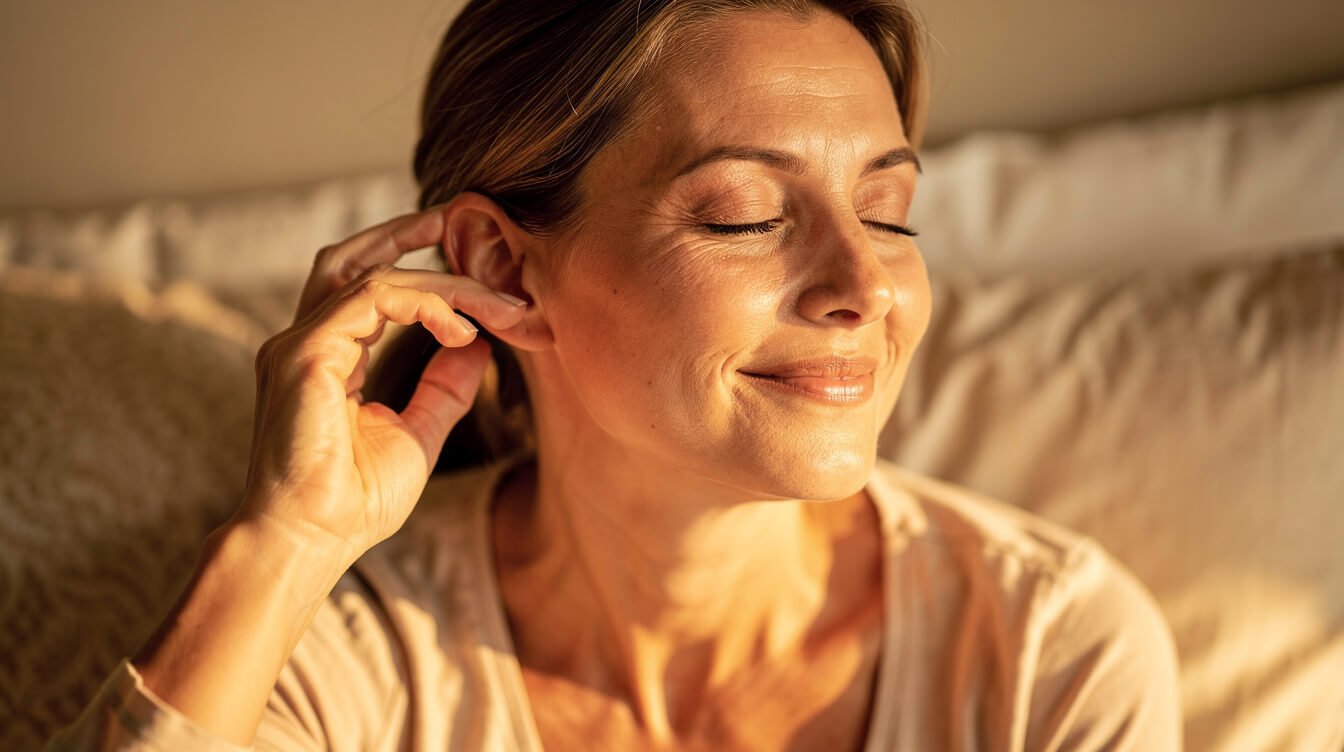
These are the points that come up most often in sleep traditions and in the research above. You don’t need all eight. Most people settle on three or four favorites. We’ve grouped them from head to foot.
1. Anmian, “Peaceful Sleep”
在哪裡: Behind each ear. Find the bony bump just behind your earlobe (the mastoid bone), then slide your fingertip back and slightly up into the soft hollow behind it.
如何: Use both middle fingers at once and make slow circles for 1–2 minutes. This one is easy to do lying on your back.
傳統用途: As the name suggests, it’s one of the classic sleep points, traditionally used for restlessness and an overactive mind at bedtime.
2. Yintang, the point between the eyebrows
在哪裡: Midway between the inner ends of your eyebrows, just above the bridge of your nose.
如何: Rest your middle finger here and press lightly, or make tiny circles, for 1–2 minutes with your eyes closed. Use lighter pressure here than anywhere else.
傳統用途: Calming the mind and easing tension around the forehead and eyes. Many people find it the most soothing point of all.
3. Fengchi (GB20), “Wind Pool”
在哪裡: At the base of your skull, in the two hollows between the big neck muscles and the bony bumps behind your ears.
如何: Cradle your head with your fingers and press upward with both thumbs for 1 minute. Breathe out slowly as you press.
傳統用途: Tension in the neck and head, which often keeps people awake. It’s a favorite in our 緩解頭痛的穴位按摩 也是日常作息。
4. Shenmen (HT7), “Spirit Gate”
在哪裡: On the palm side of your wrist, on the crease, on the little-finger side. Feel for the small hollow just inside the tendon that runs up from your pinky side.
如何: Press with your opposite thumb for 1–2 minutes, then switch wrists.
傳統用途: Settling the mind. It’s the best-studied sleep point. Sun and colleagues (2010) used HT7 on its own in their sham-controlled care-home trial.
5. Neiguan (PC6), “Inner Gate”
在哪裡: On the inner forearm, about three finger-widths above the wrist crease, between the two central tendons.
如何: Press firmly with your thumb for 1–2 minutes on each arm.
傳統用途: Easing nervous tension and an unsettled stomach. It’s the same point that travel-sickness wristbands press on. A nice choice if worry shows up in your gut.
6. Sanyinjiao (SP6), “Three Yin Intersection”
在哪裡: On the inner lower leg, about four finger-widths above the tip of your inner ankle bone, just behind the edge of the shin bone.
如何: Press with your thumb for 1 minute on each leg. It’s often quite tender, so start gently.
傳統用途: Relaxation and sleep, and often paired with HT7 in studies.
⚠️ Skip it if you’re pregnant. Traditionally SP6 is avoided during pregnancy, so leave it out unless your midwife or doctor says it’s fine.
7. Taichong (LV3), “Great Surge”
在哪裡: On the top of your foot, in the dip between the bones of your big toe and second toe, about two finger-widths back from the web.
如何: Press and hold with your thumb for 1 minute on each foot.
傳統用途: Releasing irritability and “wired” tension, the kind of restlessness that comes after a frustrating day.
8. Yongquan (KD1), “Bubbling Spring”
在哪裡: On the sole of your foot. Curl your toes, and look for the small dip that appears about a third of the way down from the base of your toes.
如何: Press firmly with your thumb, or roll the sole gently over a tennis ball, for 1 minute per foot.
傳統用途: “Grounding” and drawing energy down from a busy head. It also feels great if your feet run cold at bedtime. Our guide to 夜裡腳冷 explains why warm feet and easy sleep tend to go together, and our 足部按摩的好處 guide has a simple routine to build on.
A 5-Minute Bedtime Acupressure Routine
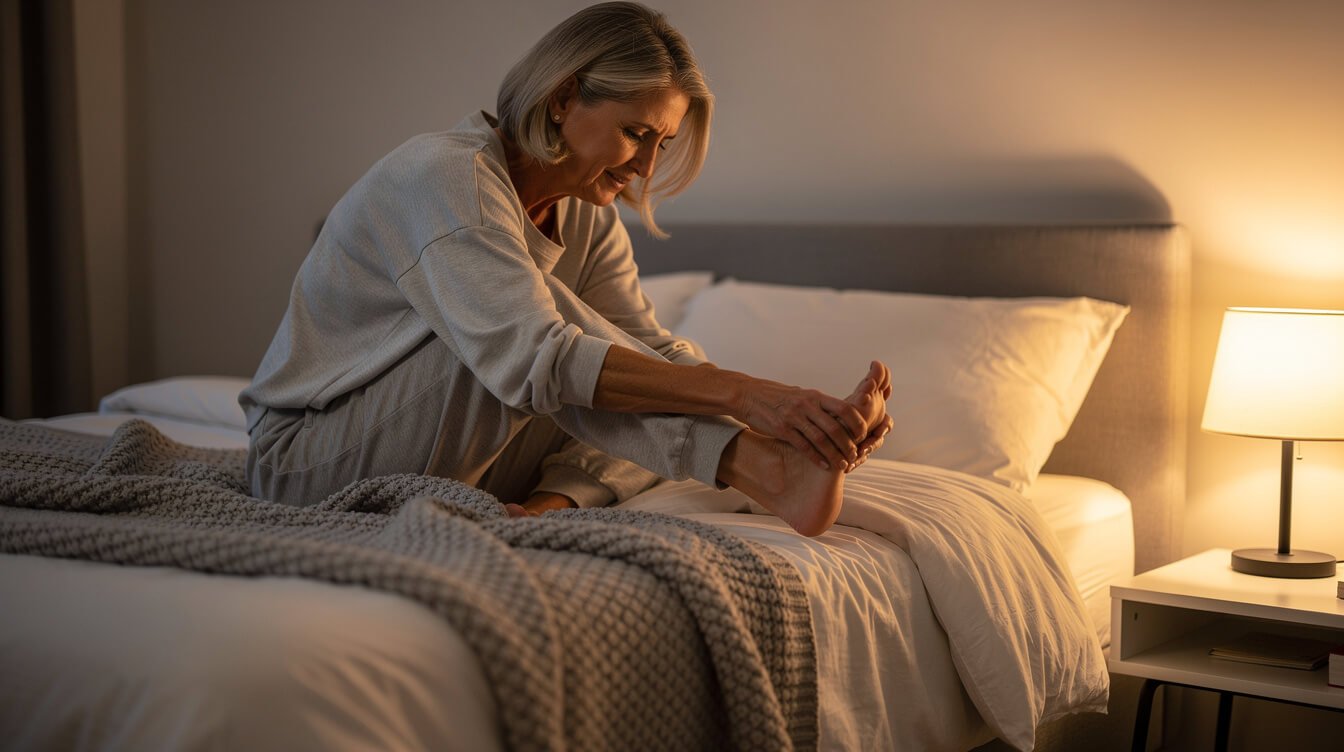
This routine strings together the points that are easiest to reach in bed. Dim the lights first, put your phone out of reach, and let each exhale be a little longer than the inhale.
| 時間 | 觀點 | 該怎麼辦 |
|---|---|---|
| 0:00–1:00 | Shenmen (HT7) | 30 seconds per wrist. Sitting up against your pillows, press the little-finger side of the wrist crease. |
| 1:00–2:00 | Neiguan (PC6) | 30 seconds per arm, three finger-widths above the crease. |
| 2:00–3:00 | Yongquan (KD1) | 30 seconds per foot. Bend your knee and bring each foot toward you, or skip it if that isn’t comfortable. |
| 3:00–4:00 | Anmian | Lie down. Both hands behind the ears, slow circles, eyes closed. |
| 4:00–5:00 | 銀塘 | Light pressure between the eyebrows. Count 10 slow breaths, then let your hands rest on your belly. |
The 2-minute middle-of-the-night version
If you wake at 3 a.m., don’t reach for your phone. Lie still and press HT7 on one wrist, then the other, for 30 seconds each. Finish with Anmian for a minute while breathing out slowly. If you’re still wide awake after about 20 minutes, the CBT-I advice is to get up, go somewhere dim and do something quiet until you feel sleepy. We’ll explain why below.
Make it a ritual
The routine works best when it’s linked to the same cues each night: the same lamp, the same blanket, maybe the same cup of something warm. Our guide to 有助於放鬆的草本茶 has a few gentle options, and some people like to add a few rounds of 緩慢呼吸練習 before the pressure points.
If you enjoy a little warmth as part of your wind-down, for example across the back of the neck or the soles of the feet before you start your points, the OlyLife活力魔杖 is a handheld terahertz and PEMF wellness device that many of our customers use for exactly this kind of slow self-care moment. It’s designed to support relaxation and general wellbeing, not to diagnose or treat insomnia or any other condition. If you have numbness in your feet or diabetes, ask your doctor before using warmth there.
🎁 領取免費健康禮品
在下方輸入您的姓名和電子郵件地址,即可免費獲得 OlyLife 提供的特別健康禮物!
Pair Pressure Points With the Habits That Matter Most
Acupressure is a lovely way to wind down, but on its own it can’t make up for a body clock that’s out of sync or a bedroom full of screens. The habits below come from CBT-I and sleep-medicine guidance, and they add to whatever your fingertips are doing.
Keep a steady wake-up time
Getting up at the same time every day, weekends included, is one of the strongest signals your body clock gets. A consistent wake time builds “sleep pressure” for the following night. Sleeping in to make up for a bad night usually makes the next night harder.
Use the bed for sleep
This is the heart of a CBT-I technique called stimulus control. Go to bed only when you’re sleepy, not just tired. If you’re lying awake and frustrated for what feels like 20 minutes or so, get up and do something calm in dim light, then come back when you feel drowsy. Over time, your brain relearns that bed means sleep, not worrying.
Mind caffeine, alcohol and late meals
Caffeine can linger for many hours, so a mid-afternoon coffee may still be in your system at bedtime. Alcohol can make you drowsy at first, but it tends to fragment sleep in the second half of the night. A heavy meal right before bed can keep you up too.
Dim the lights an hour before bed
Bright light, especially from screens, tells your brain it’s still daytime. Soft lamps, a book and your acupressure routine are a much better way to spend that last hour. Our full guide to 睡眠衛生小貼士 covers the bedroom basics, and 如何自然地改善睡眠品質 goes further into light, temperature and movement.
Give worries a place to land
If your mind starts listing tomorrow’s jobs the moment your head hits the pillow, try a 10-minute “worry window” earlier in the evening. Write each worry down, plus one small next step. Then, when it pops up at night, you can remind yourself that it’s already on paper. For more ideas, see our guide to 緩解焦慮的自然療法.
Many people also ask about supplements. If you’re curious, our evidence-graded guides to 鎂有助於睡眠 和 自然睡眠療法 go through what’s worth discussing with your doctor.
A Calm Ritual for Your Evenings 🌿
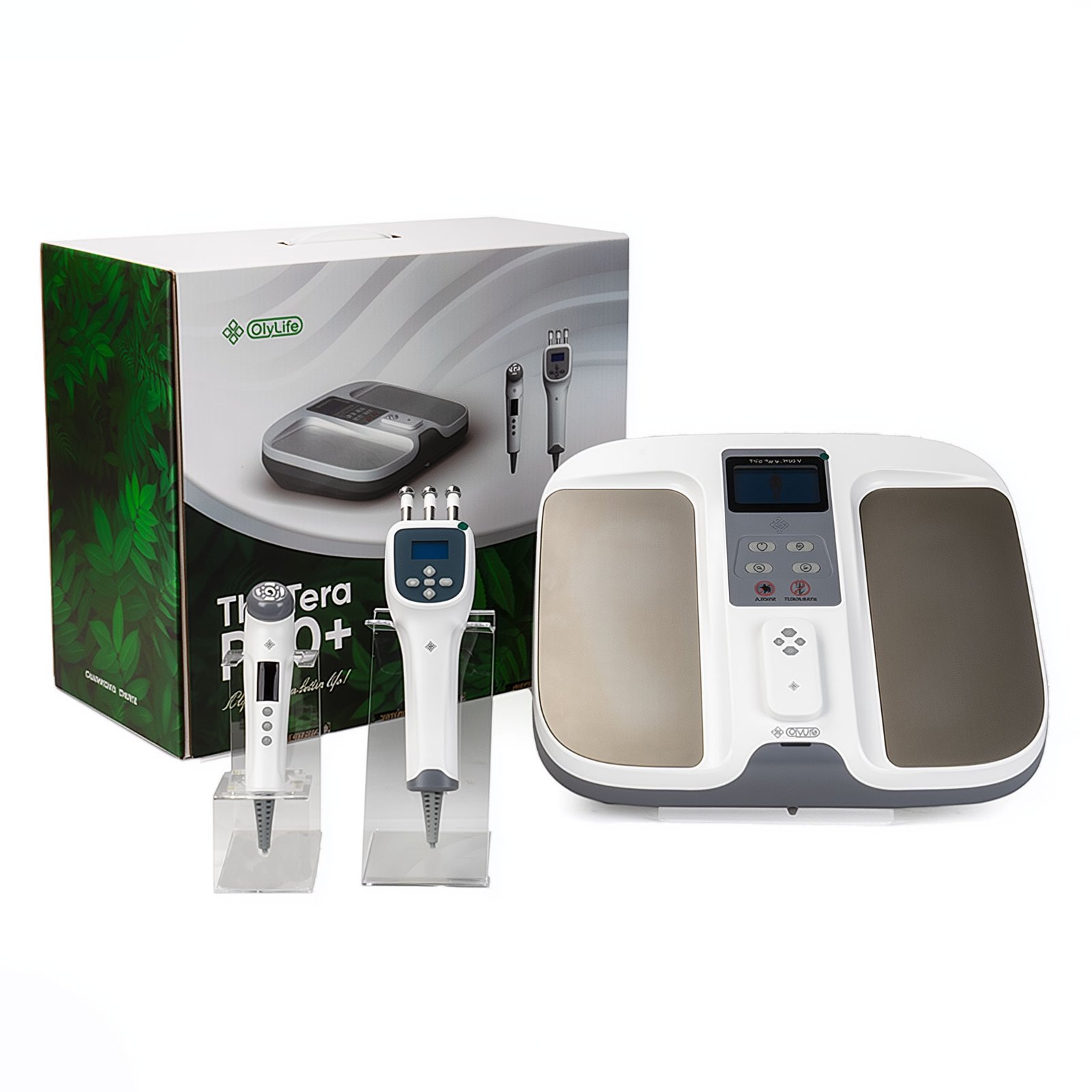
If a slow, screen-free evening helps you unwind, the OlyLife THz Tera-P90+ is designed to deliver focused PEMF and terahertz frequencies during relaxing at-home sessions, with a Revitaluxe Massager included. Many customers enjoy it as part of their wind-down before bed. It’s intended to support relaxation and general wellbeing. It isn’t a treatment for insomnia or any other sleep condition, so please keep your doctor in the loop.
Safety: Who Should Be Careful, and When to See a Doctor

Gentle self-acupressure is very low-risk. None of the trials in the Waits review reported adverse effects. Still, a few groups should take extra care:
- 懷孕: Leave out SP6 and Hegu (LI4, the web between the thumb and index finger), which are traditionally avoided in pregnancy. Check with your midwife or doctor before starting any acupressure routine.
- 服用血液稀釋劑或容易瘀青: Use light pressure only.
- Diabetes or numbness in the feet: Go gently on the foot points, and check your feet for marks afterward.
- Skin problems, swelling, varicose veins or a recent clot: Skip any point in that area.
- 藥物: Acupressure can sit alongside your current care, but don’t stop or change a sleep medication without talking to your prescriber.
When sleeplessness needs a doctor’s look
Book an appointment if any of these sound like you:
- Trouble falling or staying asleep at least 3 nights a week for 3 months or more, which is the usual threshold for chronic insomnia. Ask about CBT-I. It’s the first-line approach recommended by the American College of Physicians (Qaseem 2016), and it’s now widely available online and in apps.
- Loud snoring, gasping or pauses in breathing that a partner notices, or heavy daytime sleepiness. These can be signs of sleep apnea.
- An urge to move your legs that gets worse in the evening (see our guide on 如何預防不寧腿症候群).
- Low mood, persistent anxiety, or sleep problems that started with a new medication, pain or another health change.
- Falling asleep while driving or at other risky moments. Don’t wait on that one.
Acupressure Points for Sleep: Frequently Asked Questions

Which pressure point is best for falling asleep?
There’s no single winner, but Shenmen (HT7) on the wrist has the most direct research behind it. Anmian 和 銀塘 are the easiest to do lying down. Many people combine all three.
How long does it take for acupressure to help with sleep?
Some people feel calmer after the first session. In the trials, though, the benefits built up over 4 to 8 weeks of daily practice, so give it a fair trial of a few weeks before you decide.
Can I use acupressure if I take sleeping pills?
Generally, yes. Gentle self-acupressure doesn’t interact with medication. Just don’t use it as a reason to stop or change a prescription on your own. Talk to your doctor about any changes.
指壓療法和針灸一樣嗎?
They share points and traditions, but acupuncture uses fine needles placed by a licensed practitioner. Acupressure uses your fingers, so you can do it safely at home. Most sleep research focuses on acupuncture, and the acupressure trials are smaller.
What about ear seeds and acupressure mats?
Ear seeds (auricular acupressure) have been studied for sleep, especially in hospital and cancer-care settings, with mixed results. They’re best placed by a trained practitioner. Acupressure mats are a different experience, more like a full-back stimulation. Some people find them relaxing before bed, but they haven’t been studied the way specific points have.
會痛嗎?
No. Aim for “good pressure,” around a 4 to 6 out of 10. A dull ache that eases as you breathe is normal. Sharp pain, tingling that spreads or bruising means you should ease off.
Final Thoughts: Gentle Hands, Quieter Nights
Acupressure points for sleep won’t flip a switch overnight, and the research is still catching up with the tradition. What they offer is a simple, free and very low-risk ritual that gives a busy mind something soft to hold onto. The best studies suggest that a few minutes a night, practiced for several weeks, may help you fall asleep a little faster and wake feeling a little more rested.
Start small. Pick three points you like, such as HT7, Anmian and Yintang, and pair them with a steady wake-up time and a dim, screen-free last hour. If sleepless nights keep going for months, see that as a reason to ask about CBT-I, not as a failure on your part. Sweet dreams. 🌿
參考
- Waits A, Tang YR, Cheng HM, Tai CJ, Chien LY. Acupressure effect on sleep quality: a systematic review and meta-analysis. 睡眠醫學評論. 2018;37:24-34. PMID: 28089414.
- Yeung WF, Yu BY, Chung KF, et al. Self-administered acupressure for insomnia disorder: a randomized controlled trial. Phytomedicine. 2022;99:153993. PMID: 35193046.
- Yeung WF, Ho FY, Chung KF, et al. Self-administered acupressure for insomnia disorder: a pilot randomized controlled trial. J Sleep Res. 2018;27(2):220-231. PMID: 28884877.
- Dincer B, İnangil D, İnangil G, et al. The effect of acupressure on sleep quality of older people: a systematic review and meta-analysis of randomized controlled trials. Explore (NY). 2022;18(6):635-645. PMID: 34952800.
- Sun JL, Sung MS, Huang MY, Cheng GC, Lin CC. Effectiveness of acupressure for residents of long-term care facilities with insomnia: a randomized controlled trial. 國際護理研究雜誌. 2010;47(7):798-805. PMID: 20056221.
- Ruan JY, et al. Effects of sleep hygiene education for insomnia: a systematic review and meta-analysis. 睡眠醫學評論. 2025. PMID: 40449065.
- Yeung WF, Chung KF, Poon MM, et al. Acupressure, reflexology, and auricular acupressure for insomnia: a systematic review of randomized controlled trials. 睡眠醫學。 2012. PMID: 22841034.
- Cheuk DK, Yeung WF, Chung KF, Wong V. Acupuncture for insomnia. Cochrane Database Syst Rev. 2012;(9):CD005472. PMID: 22972087.
- Qaseem A, Kansagara D, Forciea MA, Cooke M, Denberg TD. Management of chronic insomnia disorder in adults: a clinical practice guideline from the American College of Physicians. Ann Intern Med. 2016;165(2):125-133. PMID: 27136449.
- Morin CM, Jarrin DC. Epidemiology of insomnia: prevalence, course, risk factors, and public health burden. Sleep Med Clin. 2022;17(2):173-191. PMID: 35659072.
- Liu Y, Wheaton AG, Chapman DP, et al. Prevalence of healthy sleep duration among adults — United States, 2014. MMWR. 2016;65(6):137-141. PMID: 26890214.
- VA Portland Health Care System. Acupressure for Sleep (patient handout 4312). 2021.