Saturday Spotlight: Gua Sha — The Ancient Stone Ritual for a Calm, Unhurried Morning
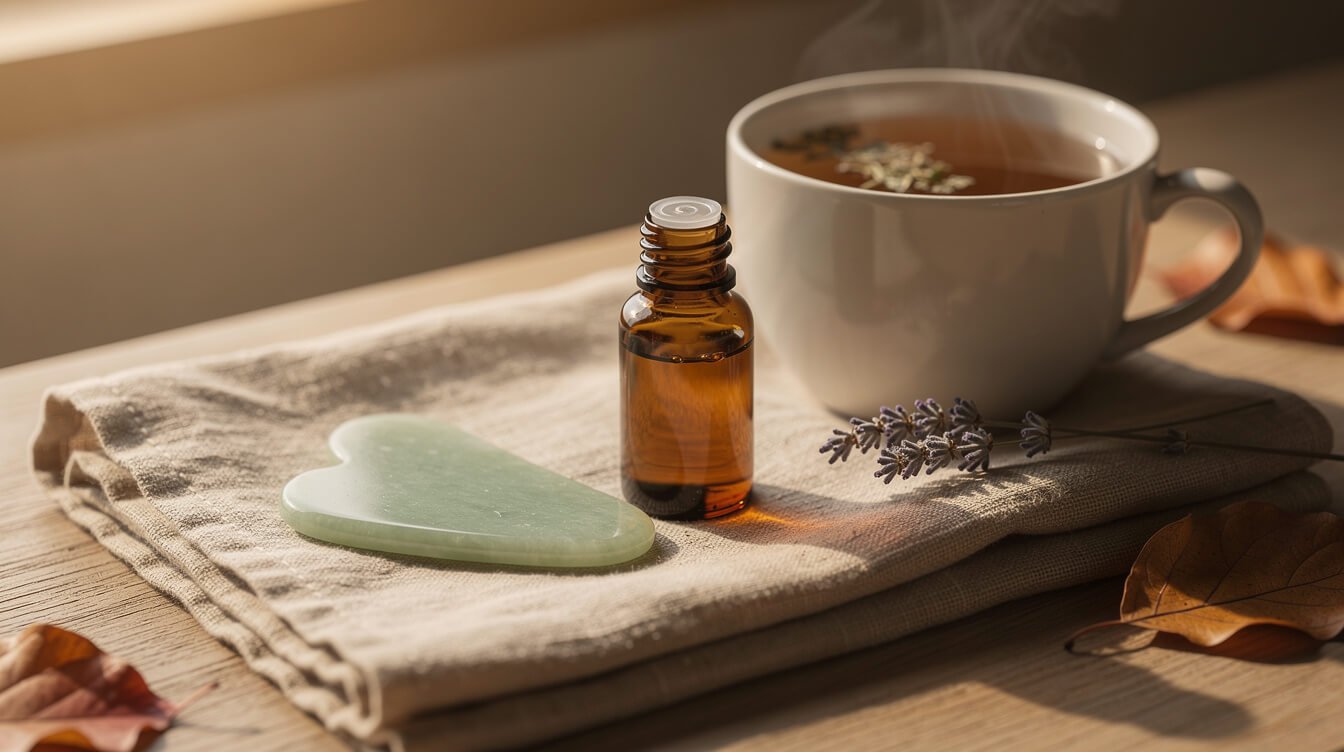
This week’s Saturday Spotlight is about a smooth, palm-sized stone and one of the oldest self-care rituals around. Gua sha (pronounced “gwah shah”) is a traditional East Asian technique where you glide a smooth-edged tool along oiled skin. It has been used for centuries in Chinese, Vietnamese and other folk-healing traditions. These days it also shows up in plenty of bathroom-shelf skincare routines. Here’s what it is, what research suggests, and how to try a gentle version at home this weekend. 🌿
Two Kinds of Gua Sha
The word covers two quite different practices:
- Traditional body gua sha uses firm, repeated strokes on the back, neck or shoulders. It deliberately raises a temporary red, freckled mark called “sha,” which fades over a few days. It’s usually done by a trained practitioner.
- Facial gua sha is much lighter. The stone glides over the face and neck with feather-to-moderate pressure, and it shouldn’t leave marks. This is the version most people try at home.
What Research Suggests
The evidence is early and small, but it’s interesting:
- Circulation in the treated area: In a 2007 pilot study of 11 healthy adults, a single body gua sha session was followed by a roughly fourfold rise in surface microcirculation for about 7.5 minutes, and blood flow stayed above baseline for the 25-minute measurement window (Nielsen et al., Explore, 2007).
- Neck tension: A 2011 randomized trial in 48 adults with chronic neck pain compared one gua sha session with a heat pad. A week later, the gua sha group reported greater improvement in pain (Braun et al., Pain Medicine, 2011). The trial was open-label and short, so its authors called the long-term value unclear.
- Facial gua sha: In a small 2025 trial, 34 women used either gua sha or a facial roller for 10 minutes, five times a week, for 8 weeks. Both groups saw modest changes in facial contour measurements, but there was no untreated comparison group (Ahn et al., Journal of Cosmetic Dermatology, 2025). A 2023 dermatology review concluded that facial massage tools may offer some benefit but need larger, better-designed studies (Hamp et al., 2023).
So gua sha is best thought of as a pleasant, hands-on ritual that may support relaxation and local circulation. It isn’t a treatment for any condition.
A Gentle 5-Minute Facial Gua Sha Routine
- Start clean and slick. Apply a few drops of facial oil or a rich moisturizer so the stone glides without tugging. (Your dry winter skin will appreciate it, too.)
- Hold the stone nearly flat, at about a 15-degree angle to your skin.
- Neck first: stroke gently downward from just under the jaw toward the collarbone, 3–5 times per side.
- Jaw and cheeks: glide outward from the chin along the jawline toward the ear, then from beside the nose across the cheek, 3–5 times each.
- Brow and forehead: sweep from the center of the forehead out toward the temples. Pause there for a slow breath.
Keep the pressure comfortable. If you see redness that lingers, or any bruising on your face, ease off. Cleaning the stone with mild soap and water after each use keeps it hygienic.
🎁 Get a Free Wellness Gift
Enter your name and email below to receive a special wellness gift from OlyLife — absolutely free!
When to Skip It
Don’t use gua sha over broken, irritated or sunburned skin, active acne or rashes, recent injuries, or areas with varicose veins. If you take blood thinners, bruise easily, have a bleeding or clotting disorder, are pregnant, or have recently had cosmetic injections or facial procedures, check with your healthcare provider first. For body gua sha, see a trained practitioner rather than DIY-ing the firmer technique.
The Takeaway
Gua sha won’t transform your face or fix a sore neck overnight. But five unhurried minutes with a cool stone, a little oil and some slow breaths can be a lovely way to slow down on a Saturday morning. ✨ If you enjoy hands-on self-care, try pairing it with our tennis ball self-massage routine or these traditional acupressure points for headache relief. And for keeping skin comfortable as the air turns cold, see our dry winter skin FAQ.
This post is for general wellness education and isn’t medical advice. If you have ongoing pain or a skin condition, please talk with a qualified healthcare provider.
References
Nielsen A, et al. The effect of Gua Sha treatment on the microcirculation of surface tissue: a pilot study in healthy subjects. Explore (NY). 2007;3(5):456–466.
Braun M, et al. Effectiveness of traditional Chinese “gua sha” therapy in patients with chronic neck pain: a randomized controlled trial. Pain Med. 2011;12(3):362–369.
Ahn SH, et al. Comparative effects of facial roller and gua sha massage on facial contour, muscle tone, and skin elasticity: randomized controlled trial. J Cosmet Dermatol. 2025;24(6):e70236.
Hamp A, et al. Gua-sha, jade roller, and facial massage: are there benefits within dermatology? J Cosmet Dermatol. 2023;22(2):700–703.